Pages

Showing posts with label Rants. Show all posts

Tuesday, August 30, 2011

Goodbye, Borders

Yesterday I paid what will likely be my last visit to a Borders Books. Here's a typical shelf in their store:
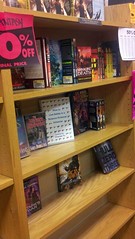

2011-08-29_12-57-48_776

As you can see, things are about half-full, like some carcass partially picked over by a small flock of vultures. What's there is kind of in order, but not really. The staff seemed more interested in selling the tables and bookcases than in helping confused customers find books. And frankly, I don't blame them.


It was a melancholy experience for me. I grew up in the Virginia suburbs of Washington, D.C. Up through high school the only game in town were B. Dalton's and Waldenbooks. Nice stores for their day but pretty small in comparison to what we've become used to. I'm pretty sure the stores from my youth would only barely hold the regular fiction collection of a Borders or B&N, so when Borders first came to the area when I was in college it was like a revelation. And it wasn't just about size.


You mean you don't stick Sci-Fi into the darkest, loneliest corner of your store?


You mean you actually carry comics and graphic novels? Like on the shelf?


And you'll special order stuff for me and not sneer at me while you do it?


For the first time since I was a little kid I actually felt welcome in a bookstore. It was fantastic and I made a point to visit it every time I came home from college so I could stock up on pleasure reading for the semester.


As I've gotten (much) older and my tastes have changed I've found less and less by just browsing in their stores, but certainly more than I do when I browse their main competitor. Losing all of these stores will be a loss for many communities.

2011-08-29_12-59-01_435

Take where I live: Prince George's County, Md. A suburb of Washington, D.C. Population of 863,420 and, according to Wikipedia, "the wealthiest African-American majority county in the nation". With the Borders stores closing, that sadly leaves all of two bookstores in the entire county. When the location in Landover shut down a few months ago it ended a series of weekly kids programs, teen book groups, adult book groups, an anime club, author readings, and a place many went just to read, write, and use their internet while sipping coffee. Say what you will about poor business decisions by corporate and ineffective competition, but around here I know book lovers will feel a real sense of loss when these stores shrivel up.


Excelsior

Sunday, July 19, 2009

New Thoughts on the Avant Garde

I recently finished Tracy Daugherty's wonderful book Hiding Man: A Biography of Donald Barthelme. While I am still digging through my notes and marked passages, one particular quote of Don B keeps coming up:

the function of the advance guard...is to protect the main body, which translates as the status quo

At least for me, this is a different way of thinking about the avant garde side of arts. Blame my binary brain but I often think of the avant garde as an antagonistic force, a side of the arts that seeks to lay waste to everything that came before and define its age through a new style or new philosophy. A session on reading difficult writers I went to at this year's Balticon solidified it for me: when people around the room took turns announcing their favorite authors nearly everyone groaned when one brave man pledged his allegiance to Thomas Pynchon.

But this small line of Bartheleme's hints at more of a symbiosis. Constantly pulling on each other to go one way or another, the two sides need each other to define themselves. Even more, it's the avant garde that steps out to try new forms and new ideas, to take the blasts venomous criticism so more mainstream lit can (possibly) borrow and modify what they do years later.

As a writer who took chances by playing with the form but still managed to publish work in mainstream mags, I can't think of anyone else at a better vantage point than Barthelme to make a statement like this. While this idea is still very fresh in my head----and thus about as firmed up as a pile of silly putt----I'm hoping to mull on it for awhile and start seeing connections the more I read. We'll see.

I'll have more of a formal review of the bio later this week, after I finish going through my note. Until then....

Excelsior

Friday, May 08, 2009

Cover to Cover

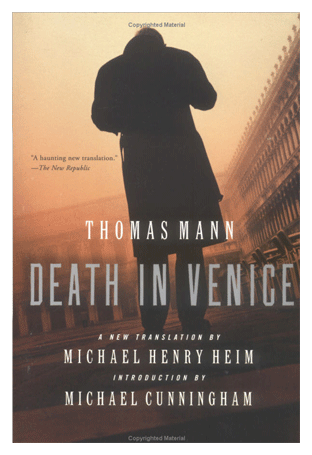
Yesterday at work we were pulling books for a book club----their choice for the upcoming month is the wonderful short novel by Thomas Mann entitled Death in Venice. Something about the cover was bothering us for some reason. It looked familiar but we couldn't figure out why.


cover


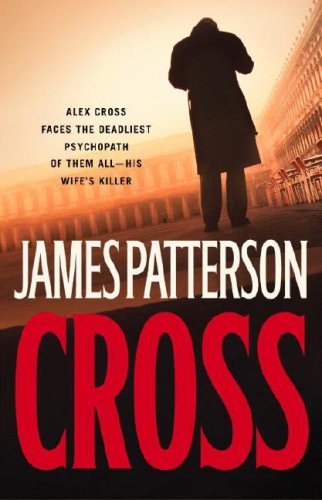
Later in the day, one of my co-workers said, "Here it is!" He was holding a completeley different book, Cross by James Patterson. Cover that looks startlingly similar.


0316159794.01


Now we are used to seeing books with similar covers, but they are usually part of the same series or at least by the same author. But we've never seen anything quite like this.

My first thought was that they are by the same publisher and that publisher owns the rights to the photograph used on both covers. But the Patterson novel is from Little, Brown while Mann's is by Harper Perennial. So I have no idea, unless this image is in the public domain. Today I'm going to try to find out more info on the photo and where it comes from. It's supposed to be nice today, so I'm expecting it to be a bit slow at work. Having a harmless mystery like this will help the time go by.

Excelsior

Sunday, September 21, 2008

And Now Back to our Regularly Scheduled Program

Miss L and I were sitting around yesterday morning, doing a whole lot of nothing before actually starting our Saturday. I was watching an unhealthy mixture of bad cartoons and Good Morning America while reading a few pages of Zeroville. Miss L was jumping around on the web.

All of a sudden she said, "You know, you really need to update your blog."

I looked up to see the same page that's been on this space for almost two months now, my review of Out Backward.

I shrugged. "I've been busy."

"Uh-huh," Miss L said. "No one's going to look at it if you don't update it."

I shrugged again, a gesture proclaiming my not caring without committing to not caring.

"Why do you even keep it public if you aren't putting any new content on it?" she asked.

I didn't have an answer for that one. At least not a real one. After a day of thinking on it now I realize there is no answer. Oh I can make excuses. I've got all kinds of those. I've been focused on moving from Virginia to Maryland. I've been looking for a full time librarian job. I've been preparing for our wedding next month. But none of that takes writing away from me, or at least it shouldn't.

Writing is, first and foremost, a craft that demands habitual dedication. It asks that every day, or at least nearly ever day, you write something. Be it a book review, a descriptive paragraph of someone in a coffee shop or a complaining rant on nothing in particular (like this one). If you don't do that the craft takes things away from you, and I don't just mean your writing skills.

One of the main reasons I started this blog was to reclaim the habit of writing frequently. Somewhere along the line, I'm not sure exactly where, I lost it. I'll be trying some things here to reclaim it and for any of you still willing to ride along, I thank you.

Excelsior.

Thursday, December 06, 2007

Metro, Why Have You Spurned Me So?

Damn Metro

I was flying high earlier today. We finished up the group project on disaster plans for my University Libraries class, and I was feeling pretty good about it. I spent most of last night editing, streamlining and honing what we had and I think we had a pretty good paper set to hand in. On top of that, I was feeling pretty good about the presentation we had to make on the topic as well.

I left for class a good hour early. Sometimes metro gets spiteful and things can take 30 minutes or so longer than you plan on. It often happens when you least want it to, and I wanted to make sure I was on campus in plenty of time. Unfortunately an hour wasn't nearly enough of a buffer today.

I was happily sitting in my seat on the train, half reading an old interview with Mark Leyner and half watching the scenery flit by. The driver's voice came over the load speakers and I heard the least favorite words of metro commuters around the world, "I've just received reports of a suspicious package at the Pentagon Metro stop. We can't go any farther than Pentagon City. Any passengers wanting to go downtown can catch a free shuttle bus."

I shrugged my shoulders and thought I'd still be ok. But when I came out of the metro stop instead of finding a shuttle ready to take me downtown I found a writhing, angry mob full of people ready to be just about anywhere but that street corner. There were probably three train-fulls of people there, and more filing in behind me.

Shuttles were provided, but only about every 20 minutes. Each one barely made a dent in the crowd. And for some reason every other shuttle was going south instead north, the way to downtown. No one seemed to understand that, not even the metro employees doing what little they could to keep a frustrated mob informed. After an hour or so, I made it half-way through the mass of people. Only another hour of waiting and salvation would be mine. Fortunately, the trains started run soon after that and I finally made it to campus.

Long story short, I eventually made it. A ride that normally takes an hour and fifteen minutes took three and half hours. Thanks to a quick phone call to Miss L, I was able to get an email to the other two people in my group and they were very nice about the whole thing. I made it just in time to be the last group make a presentation and it went pretty well, despite my bedraggled look and spent emotions when I first got there.

Why am I blogging about this? I have no idea. I just know these metro problems have been hitting me more frequently the last few months than they ever did when I rode metro every day. But you never realize how much you depend on things like public transportation to work until they fail. We humans really are quite hopeless little creatures.

Ah well. One more paper to go. This one's an annotated bibliography on reference sources for science fiction. So hopefully this one will be fun.

Excelsior.

Monday, November 05, 2007

Standing Up for Joyce

There's this woman in both of my classes this semester who drives me nuts. Whether it's just before class or during a break she spends her whole time complaining about or ridiculing everyone and everything in her life. Her professors aren't good teachers. Her classmates can't write well. Her coworkers aren't well read. And on and on.

Most of the people she talks about I don't know, but a few I do know. Up till now i've always kept my mouth shut. So what actually prompted me to speak up against her? Who was her target today? A close friend of mine? A professor I admire?

No.

Her target today was James Joyce.

She's apparently taking a class outside the Library Science program on Joyce's Ulysses. She was talking about it offhandedly to the professor for my class tonight, that she didn't understand why it's considered such a high point in literature. She said she didn't like the style, didn't like the writing and she had a hard time believing that Joyce was friends with Hemingway when they were both in Paris.

"Well, they were both out-of-towners in the pretty snobby art world of Paris," I said. "They probably needed the comraderie. And I think they were both able to appreciate one another's writing, even if their styles are vastly different."

She just shrugged her shoulders, and everything probably would have been fine if I left it at that. But I opened my big mouth again and tripped over my own big fat tongue.

"But I guess I can understand your feelings because I don't really care for Hemingway much," I said.

Her face snapped into my direction. "What...you don't like Hemingway?"

"No, not really," I said. "His characters have never seemed like people to me. They've always felt more like props for his ideas. Especially his women."

She then rattled off three or four stories to combat my opinion. I shrugged and said, "Sorry. I just don't like him."

I was very careful to stress that it was my opinion, that I didn't feel that people couldn't like him. But, whether it was my words or simply that I was contesting her own opinion, she took it personally. She glared at me the rest of the period and, after awhile, I started to feel guilty. I don't know why, I just did.

What's the point of all of this? I have no idea. I do wonder why, of all people, the person I stood up for was a dead Irish author.

Excelsior.

Wednesday, October 24, 2007

On My Comic Book High Horse

Comics blogger Jog has an interesting write up/reaction to New Engineering, a wild looking collection of Manga by Yuichi Yokoyama. After describing the nearly plotless content of the book filled with continual battle scenes and bizarre landscapes, Jog gets into a nice little discussion on the expectations of US readers of manga.

It's Naruto's library of symbols, stripped of warmth and purpose, and turned into something... else.

So, in essence, it's the style of Manga, using sweat drops and nose bleeds aplenty. but it's Manga knocked on its butt until it's doing something else. Sounds pretty cool to me. But this speaks a lot to the US perception of comics and cartoons in general; Sandman and Fun Home aside, mainstream media still hasn't embraced the idea that comics aren't just brain candy for kids. Probably every couple of weeks someone I work with at the library will ask me, "So...I know you read books, too. What's the point with all these graphic novels?"

I just shake my head. What people continually seem to confuse is that they relate comics to their idea of genre, while it's really a medium that can tell all the same kinds of stories told entirely through text (and even some that you can't tell through text). Sci-fi, super-heroes, romance, humor, somber tales of regret, even experimental fiction like Karasik & Mazzucchelli's wonderful adaption of Paul Auster's City of Glass. It's not the tools used but what's done with them that matters.

I admit I'm biased, though. And I have been checking out a lot of fluffy ones lately, mostly because they provide a much needed break from all the academic papers I have to read for my classes. Just try not to look at me with too much scorn when I check out an issue of One Piece, a Chris Ware Lit-comic, and the latest Jonathan Lethem novel all at the same time. I enjoy it all.

Excelsior

Friday, May 11, 2007

Promise of a Premise

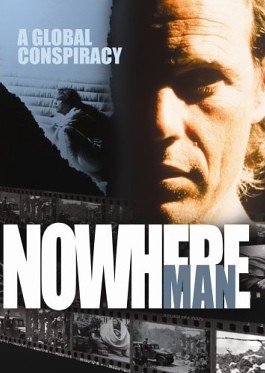
One of the great joys of Netflix is getting to revisit old t.v. obsessions. This past week I've been reliving one of my favorite shows from the mid 90's, a series called Nowhere Man.


nwmtitle


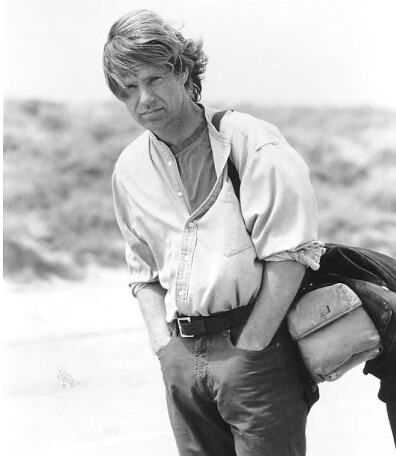
Bruce Greenwood plays Tom Veil, a successful photojournalist. The pilot episode features Veil at his first art opening and the center of his art show is a piece called "Hidden Agenda", a photograph he took in South America of an political execution. Veil's wined and dined by art critics and buyers, and, at least for the evening, is toast of the town. Of course, following Miss L's rule of drama whenever things are going too well it means something bad is about to happen.


Ha


Veil and his wife go to dinner to celebrate Veil's newfound artistic success. Midway through the meal Veil gets up to use the restroom---and sneak a few drags from a cigarette--- and he returns to find his wife missing. He questions the owner of the restaurant, who claims to not even remember him or his wife. Veil makes his way home only to find his wife with another man and claiming not to recognize Veil. Not knowing what else to do he returns to his studio to figure out what's going on.

He learns that someone wants the negatives of "Hidden Agenda" and Veil refuses. He's captured, imprisoned and, by the end of episode, finally escapes. The episodes that follow work like a dramatic dance as Veil tries to keep from being caught while also attempting to unearth clues to identity of the people who destroyed his life.

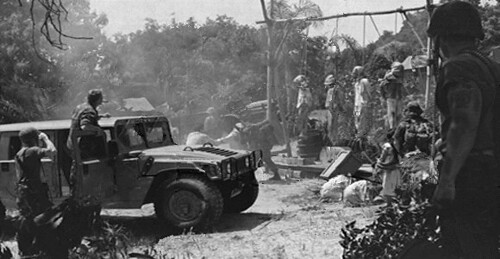
It mines some of the same grand conspiracy material as the X-Files. The nameless villains were not only able to erase every trace of Veil's life but they also seem to have control over pieces of the Army, the FBI and even television broadcasts. Not surprisingly, there seems to be a good bit of overlap with staff who worked on both shows, the most obvious being Mark Snow, who did the theme and incidental music for both shows.

It was a perfect cult show because it was one of those shows where you never really knew exactly what was going on. Characters and plot points from past episodes reappear, but in new ways causing you to continually question whatever assumptions you made about the show previously. Back in the day I kept a notebook filed with clues the show, and I even trolled usenet to find more clues (this was in '95, well before every t.v. show had its own message board). The series ended after 25 episodes, which let down the fans since nothing really got answered. I always wondered what the full story was and was excited to see the DVD's available. I've been enjoying them all week.

Unfortunately, I've also watched some of the DVD extras. One of them features an interview with series creator/producer Larry Hertzog. He admits a strong influence from earlier t.v. shows like The Fugitive and The Prisoner (which I really need to watch someday), but also went into some things that were a little disappointing. He said he didn't know who the ultimate villains were and that he didn't think it was important to the show. He never thought of it as a show with an endpoint, but more as an ensemble show like The Twilight Zone where writers and directors could come in and play with odd ideas. The only common threads were the character of Veil and that each episode explored a different type of paranoia.

I almost didn't believe him. It always felt like there was a larger story behind the scenes and it's too bad to discover there really wasn't. I'm apparently not alone in this since sites like Nowhereman.org host a fair amount of fan-fic. Someone with a sense of humor has even given Veil his own myspace page.
Possibly a larger story would have formed if the series had been given more time. Or maybe not. But whatever the case it's all made me think about writing and living up to the full premise of what you create. When you don't manage to do that you fail the story and you fail the audience. I, of course, also thought about one of my current favorite shows, Lost, and all the layers upon layers of unanswered questions the show still has. At one point I thought there had to be a master plan behind everything but now I wonder.


nwmwandering


In the end it might be best that Nowhere Man never reached an endpoint. If it had, the paranoia would have ended. Instead fans can still think of Veil out there wandering, questioning and struggling to find the answers. In a way a nice, albeit dark, metaphor for life.

Excelsior.

Wednesday, April 18, 2007

V-Tech

I wasn't going to post anything about the horrible events V-Tech, but I've gotten a few emails and messages through myspace asking me about it. I really don't know anything other than what's been on the news. I am in Virginia, but I'm several hours away from Blacksburg. My next door neighbor has a son there in the engineering program and he is (thankfully) ok, but that' s really my only connection to the school.

I haven't been sleeping well the last few days, so I've been listening to a lot of late night talk radio. When something like this happens all the crazies pop out of the woodwork to try to explain how and why it happened. Over the last two nights I've heard everything from "if students we're allowed to have guns, that nut wouldn't of had a chance" to "the chinese planted a microchip in that guy's brain". I even heard someone blaming creative writing programs, now that Smoking Gun and some other sites have put some of Seung-Hui's writing online. I'm more than a little angry at the way the the media has been exploring and taking advantage of this tragedy for the sole reason of ratings and not to explore ways to heal the community.

So please keep your personal and political crusades out of this. The families who lost loved ones and the entire V-tech community needs time to grieve. Please give it to them.

Excelsior.

Thursday, April 12, 2007

God Bless You, Mr. Vonnegut

I walked into work today, completely unaware of what had happened. Instead of spending the morning listening to the radio like I normally do, I was working on my projects for school and listening to music. When I got to library I was given the task of touring the shelves and pulling off titles for our current display on Shakespeare (his birthday is sometime this month). So when I saw a new display tucked away to the side of the checkout desk I had no idea what happened. Seeing familiar titles like Cat's Cradle and Bagumbo Snuffbox, I smiled. I haven't really been happy with the types of displays we've had lately, so I've made some suggestions for some. A display of Vonnegut being one them, I thought someone had finally taken my suggestion to heart.

But then I looked over and saw the sign next to the books. There was a black and white photo of Vonnegut's familiar whizened face. Below the photo it said, in plain black letters, "Kurt Vonnegut, jr. 1922-2007".

I dropped the Shakespeare books on the floor. I looked down at the books I dropped, then up at the display, then back down at the books, and then up again. I couldn't believe my eyes in either case. I walked up to the information desk, just leaving the Shakespeare books scattered on the floor.

"What happened?" I asked in a tone that was probably a little stronger than it should have been.

The librarians working the desk just looked at me, not knowing what I was talking about.

"The Vonnegut display. Is he really..."

I couldn't bring myself to say the word dead.

"He died," one of them said. "I heard it on the radio this morning. Something to do with injuries related to a fall he had a few weeks ago."

I nodded, then went back and picked up the books I had dropped on the floor. I spent the rest of day reading snippets out of his books and looking up odd quotes from him online, each one making me smile and tear up a little at the same time. Every once in awhile I'd see a patron look at the Vonnegut display, but the only person to express anything to me was a woman who had him confused with Ray Bradbury.

So it goes.


trouts_tombstone


What Kilgore Trout wanted on his tombstone, from chapter three of Breakfast of Champions


In comparison to a lot of other people, I came to Vonnegut late in life. Not until after college. Not that I hadn't heard of him or had other people suggest him to me. Tracy---this crazy-mad art girl I had a big crush on in high school----was always telling me to read him my Junior and Senior year in high school. My friend Rusty at JMU never understood how I could enjoy satirical nuts like James Morrow and not worship Vonnegut. But at that point in my life I still had it in my head that I couldn't read anything by choice that was shelved outside the sci fi section.

When I finally did get to him after college, he blew my mind. First with Cat's Cradle, then with Slaughterhouse Five, Breakfast of Champions and beyond. It was still sci-fi, but it was also something else. Something beyond. Along with Philip K. Dick and one or two others writers, Vonnegut became my bridge off the island of sci fi to the world of experimental lit. He's one of those rare writers who danced between popular, genre, experimental and mainstream fiction, each claiming him but not ever really belonging to any of them.

When I started writing I wanted to be Vonnegut. My first published piece of fiction was an introduction to an imaginary novel that was heavily inspired by Vonnegut's intro to Slaughterhouse Five. It amazed me that he was able to get away with essentially telling his whole story in the intro. Later, Breakfast of Champions cracked my head open to meta-fiction and to mixing pieces of your own life into your work. I'm still dealing with all of that garbage. Vonnegut made it all look so easy, and the more I write the more I realize how nearly impossible it is to do that.

Vonnegut made us laugh. He made us cry. And, most importantly, he made us stop and think. I can't imagine an author trying to do anything more important.

Lots of other great tributes out there to him. My favorites thus far are at And I Am Not Lying For Real, Mumpsimus and the online chat Michael Dirda did via The Washington Post.

Excelsior.

Thursday, March 29, 2007

Oprah and McCarthy

The story's been popping up on just about every book-related blog I look at, but in case you didn't know the newest Oprah book pick is Cormac McCarthy's The Road.

I'm not an Oprah fan. In fact, if there's any one celebrity I'd love to see go away it's her. Not die, per se. Just go away. But she does manage to pick interesting books. The Road is a brilliant book, but All the Pretty Horses it's not. I can't imagine what the reaction to it will be from the typical Oprah crowd. It's set just after an apocolyptic event---you never find out exactly what happened----so it's pretty dark and, at times, grisly. But at its core The Road is really about the love between a father and his son and how they will endure anything for each other. The two travel together along a nameless highway, hoping to find a better life at the coast. Be prepared cry at the end.

The O-watchers are already working full steam ahead; in the last 24 hours the library I work for has received 180 requests for the book. And I'm sure bookstores are facing a similar situation.

I do wonder, though, how the O-watchers will react to the pretty graphic scene of starving people eating a bbq'd baby.

Excelsior.

Saturday, February 24, 2007

Lost on Trafalmadore

I woke up early this morning and watched my Netflix movie of the week, Slaughterhouse Five. Being a big fan of Vonnegut's book, it's something I've meant to watch for some time but just hadn't gotten around to before now. I'm not normally one of those people who will pound my foot and say it's better to just read the book; I think of a film version of a novel as very different creation.

Vonnegut's original book works because it manages a delicate balancing act between subject matters both darkly serious and darkly comic. Move throughout the novel switching back and forth between being horrified and chuckling to yourself, often on the same page. The basic plot elements are in the movie ; Billie Pilgrim jumps through various points in his life: the bombing of Dresden during WWII, raising his dog Spot, surviving a plane crash, and living out his last days as a zoo exhibit on this distant planet of Trafalmadore. But the movie tells the story by focusing on the dark elements of the story, forgetting the comedy. Sure, there are some funny moments. There's a very slapstick scene of Billie's wife tearing up the highway in her new Caddy, trying to get to the hospital after Billie survives a plane crash. But those moments are few and far between.

I don't blame the movie on an untalented director; it was done by George Roy HIll, who directed classics like The World According to Garp, The Sting, and Butch Cassidy and the Sundance Kid. This movie made me realize that a large part of writing is creating a unique voice. Vonnegut's book would just be a forgotten wacky sci-fi novel if it wasn't for the sly, wry ironic tone we get from Billie as the narrator. Without that tone, without that litany of "So it goes" that pops up, under-cutting every tragic event Slaughterhouse Five becomes a series of tragic anecdotes that ends up numbing you to everything.

Excelsior

Friday, January 19, 2007

In Praise of Used Books

For library class this week we had to answer some basic queries using a variety of print and electronic encyclopedias. One set of questions could only be answered by using the famed 11th edition of the Encyclopaedia Britannica, published back in 1911. Fortunately, we have a copy here at Catholic U. The 11th was a real landmark edition, because it'smore than just a collection of factual articles. It also contains essays of real literary quality by people like GK Chesterton and Bertrand Russell turning it into quite the noted item for all intellectuals and literati of the time to have.


The questions we had to answer weren't hard. They were easy, in fact. But it was a lot of fun just flipping through all the tattered volumes. Even dopy entries like the one on photography were made fun with quaint illustrations. Bound in heavy green leather, pages hand-sewn to the binding, and made with quality paper, these books were made to last. Even though they had a dusty-musty smell these volumes are still likely to outlast many books just printed today. These were books with a presence, books with a history, books with a story to tell beyond the words on the page. Since all the material is now beyond the bounds of copyright protection, there are few websites devoted to recreating the original feel of the volumes, most notably Love to Know 1911 and Online 1911 Encyclopedia Britannica. While you don't get to feel the pages or smell the leather, you can at least get a sense of some of the articles and what made it such a unique project.


Don't get me wrong. I love all the developments in electronic publishing. It's been just about the most democratizing force for the word since Gutenberg. But there's just something about books as a physical object that I love.

I guess that's why I love used books. In a lot of ways, I may prefer them. There's an oddly heroic feeling when you rescue a lonely tattered volume from some random library booksale or a dusty used bookstore. Some people are bothered by notes and marginalia left by previous readers but, not me. There like little notes into people's quiet lives, and I feel like I'm sharing some odd connection with someone I'll probably never meet.

Like when I bought Italo Calvino's Baron in the Trees. I bought the book at Second Story in Dupont Circle here in D.C. on a lunchbreak and then ran down the street to eat a burger at Zorba's. I was thumbing through the Calvino novel and waiting for my order when something fell out from between the pages. It was an advertisement flier for a bookstore in Florence, Italy, of all places. I looked at it for a minute, thinking about how far this little book travelled and being quite amused that a book in English by an Italian author came to me via some Italian bookstore. I started thinking about what kind of collage projects I could use it for when a voice interrupted my thoughts.

"Excuse me, may I see that?"

I looked up and saw a man in front of me, wanting to look at the flier. I shrugged and handed it to him.

"I can't believe it," he said. "I lived in Italy when I was a teenager. I lived next to this bookstore for three years."

There was a bright light in his eyes, like a river of happy memories was flowing through his mind. I told the man how I came upon the flier and he seemed even more amused than I was. Of course, I offered it to him. He was ecstatic, slipping it into a manilla folder he had with him and swearing he was going to frame it when he got home. While I may have lost a cheap flier I gained a great memory, a great story. And a webpage can't bring me that...at least not yet.

Excelsior.

Tuesday, November 21, 2006

A Rant on Reviews via Pynchon

Thomas Pynchon's new novel Against the Day, came out today. It's a good thing none of the stores in my immediate area had it in stock. I'm enough of a fan that I probably would have dropped the $35 if I found it on the shelf. Instead now I can wait a bit, at least until I get a coupon to cut the cost a bit. I know I'll buy it, though. I have a short list of novels I count as vastly important to me and Pynchon's the only one to have written more than one.

The literati hasn't been very receptive. The reviews thus far of Against the Day have been mixed at best, but two of them in particular jump out at me as two different ways of doing reviews.

Michiko Kakutani opens her review in the NY Times with this:

Thomas Pynchon’s new novel, “Against the Day,” reads like the sort of imitation of a Thomas Pynchon novel that a dogged but ungainly fan of this author’s might have written on quaaludes. It is a humongous, bloated jigsaw puzzle of a story, pretentious without being provocative, elliptical without being illuminating, complicated without being rewardingly complex. (NY Times, 11/20/06)


Steven Moore chose this approach for his review in the Washington Post:


Pynchon fans will accept this gift from the author with gratitude, but I'm not so sure about mainstream readers. While Against the Day isn't as difficult as some of Pynchon's other novels, its multiple story lines test the memory, and some folks may be scared off by the heady discussions of vectors, Brownian movements, zeta functions and so forth, not to mention words and phrases from a dozen languages scattered throughout....Not for everybody, perhaps, but those who climb aboard Pynchon's airship will have the ride of their lives. (Washington Post Book World, 11/19/06).

To me, a reviewer should principally do three things: 1) Summarize the main ideas, 2) write briefly on the good and bad points, and 3) suggest who would like it and maybe even who wouldn't. Kakutani, for whatever reason, chose to slam the novel in her opening paragraph. While she moves on to some interesting (and balanced) analysis of the strong themes and weak characters, many would abandon reading the rest of the review after that opening. Between this and the bad review they gave Only Revolutions, I may start thinking that a bad review in the NY Times means its the perfect book for me.

More critical analysis is certainly needed in reviews, but so is the understanding that tastes in books have ranges far greater than your own. Moore suggests other viewpoints, hinting that the audience for this novel is probably limited but that there is an audience nonetheless.

Would I be bitching about this if Kakutani raved about the novel? Probably not. I admit, I am slightly defending one of my literary idols. But Kakutani's method here is one I see in reviews all the time and it's really been bothering me lately.

Excelsior

Saturday, June 17, 2006

Remembering Leary

I've had an on again/off again obsession with Timothy Leary ever since his book Design for Dying came out.

He was a brilliant man, if somewhat misguided and charmed by the cult of celebrity from time to time. What many often forget is that his early experiments with LSD were meant for rehabilition of prison inmates and were financially supported by the feds. There was nothing in Leary's mind so much as the advancement of humanity. Even after LSD and other drugs turned out not to be the panacea he hoped for he still clung to a firm belief that techology and science would, one day, save us all. So it's no suprise that when the 80's rolled around he focused more on computer technologies and space exploration and started hanging out with like-minded folk like R.U. Sirius. He dreamed of a day that everyone could plug directly into a computer and have direct access to every bit of information ever written, proved or even dreamed of. Certainly many, maybe even most, of his ideas are dated but his general sentiment of always looking forward is something that I wish more people would adopt.


Nick Gillespie just reviewed the new bio on him by Robert Greenfield for the Washington Post. Quoting here:

The biographer seems far more interested in deconstructing his subject's voluminous self-serving assertions over the years than in explaining his enduring significance to hippies, straights and cyberpunks alike. In a real way, Leary helped conjure not only the '60s counterculture but the '90s high-tech counterculture, too. A clear theme of individual fulfillment runs through all of his thought, and it's a shame that Greenfield didn't discuss his ideas more seriously, much less put them in a richer social and intellectual context. "Someone told me," Greenfield writes, " 'Those who love Timothy Leary will hate your book. And those who hated him will never read it.' " That's about right, and it reflects poorly on Greenfield's framing of the material. While his account of Leary's "most improbable life" is a fascinating read, that has more to do with subject matter that would make Philip Roth jealous than with the perspective Greenfield brings to it all.

It's unfortunate, because there are few icons out there as misunderstood and misrepresented in the public memory as Leary. Most people associate him solely with LSD and picture as some hipster doofus of a mad scientist handing out acid tabs to William S. Burroughs and Ornette Coleman at a pool party that would make Hugh Hefner question his own morals. And while those kinds of things happened, it's only a small part of Leary's story. It's been long enough that a serious, thoughtful and objective treatment of his life come together. But it doesn't appear to be this book. As an alternative, Leary's own autobiography, although a bit pompous, is a wonderful introduction to his ideas and persona. At points it's very thoughtful and often quite funny.

Excelsior.

Wednesday, May 17, 2006

The Best?

The NY Times Book Review asked roughly 200 authors and critics to nominate their choice for the best work of fiction published in the last 25 years. My notations to the side indicate that I've read it (R), that it's on my shelf to read someday (S), that I've neither read nor bought it but have considered doing so (C), that I've never thought about reading it (N), or that I've never even heard of it (H).

Overall Winner:

Beloved by Toni Morrison (R)

Runner-up:

Underworld by Don DeLillo (R)

The rest listed received nominations from more than one judge:

Blood Meridian by Cormac McCarthy (C)

Rabbit Angstrom series by John Updike (R)

American Pastoral by Philip Roth (N)

A Confederacy of Dunces by John Kennedy Toole (S)

Housekeeping by Marilynne Robinson (H)

Winter's Tale by Mark Helprin (C)

White Noise by Don DeLillo (R)

The Counterlife by Philip Roth (C)

Libra by Don DeLillo (R)

Where I'm Calling From by Raymond Carver (N)

The Things They Carried by Tim O'Brien (R)

Mating by Norman Rush (N)

Jesus' Son by Denis Johnson (H)

Operation Shylock by Philip Roth (C)

Independence Day by Richard Ford (C)

Sabbath's Theater by Philip Roth (C)

Border Trilogy by Cormac McCarthy (C)

The Human Stain by Philip Roth (R)

The Known World by Edward P. Jones (N)

The Plot Against America by Philip Roth (S)

To be honest, I haven't been paying that much attention to the NY Times Book Review lately. I just haven't had the time. I found out about the list, being published in the May 21 issue but currently available online, through various listservs and newsgroups I'm on for different genres of writing (sci-fi, fantasy, and experimental lit). Most are complaining about the list, about how their favorite genre is under-represented. Or not represented at all. A quick look at the list of judges will tell you why.

Out of the 100+ judges listed only a handful can really be considered experimental (Ben Marcus, Lorrie Moore, Rick Moody, and maybe Jonathan Safran Foer). The numbers drop even more if you ask about genre writers, with Stephen King as the only true genre writer and afficionados like Jonathen Lethem and Andre Dubus III thrown in for good measure. The playing field's also greatly narrowed by the judges' ties to geography; a gross number of the writers listed are fully immeshed in the NY scene supported by the mags like the New Yorker. They will, naturally, pick books they've read and talked about within their own world. It wouldn't occur to them to nominate a book outside their area of knowledge. So I don't fault the judges at all for the narrow selection; I fault the NY Times for not seeking out a broader spectrum of judges.

I have no personal problem with anything chosen. The books listed are certainly well crafted and many have been very influential. The winner, the runner-up and a couple of others would be on a list of my own if I had to make one (I wouldn't). The list does, however, point out a continual bias with the NY Times to support certain types of literature and certain styles of writing.

For any attending Book Expo this week, they are holding a seminar Thursday afternoon discussing the choices. If anyone happens to go, I'd be curious to know what they say.

Excelsior

Saturday, November 19, 2005

Potterific

Yesterday Miss L and I took a break from everything and took in a matinee of the new Harry Potter movie, Goblet of Fire. As a preface, I'll make it known that I'm not a mega-fan of all things Potter. I've enjoyed the books I've read (about half of them) and the movies have all been pretty entertaining but I don't approach Potter with the sheer mania and extreme fandom some seem to. My boss at work, for example, re-read the entire series thus far in the weeks leading up to the release of the HP novel that came out this fall. She also keeps pretty extensive notes on everything Potter, trying to forecast future plotlines like some great psychic. Her fandom is not limited to HP, though. The background image on her computer at work is a mildly racy photo of actor Scott Bakula.

But I was writing about Harry Potter.

Goblet of Fire is a surprisingly fun movie. From someone who's only read the book once, and not in some time, I was really pleased. It's much better paced than the last HP movie and Finnes as Voldemort is one of the creepiest figures I've seen in recent cinema. I won't go so far to call it great art, but it's probably the movie I've enjoyed most on a sheer entertainment level this year, with Batman Begins coming in at a very close 2nd. The challenges the four go through for the Tri-Wizard contest made me think a bit more about some of my plot twists and obstacles, and I'm rethinking them a bit. Because, at least for now, it's all about the NanoNovel. I can't even walk down the street anymore without thinking how it might tie into the NanoNovel.

Excelsior.

Wednesday, November 16, 2005

Google Print

I know this topic already is taking up a lot of bandwidth, airtime and printspace in lots of other venues, but it's important enough to spread as much info as possible.

Tomorrow representatives from Google, the Author's Guild and the Association of American Publishers will meet in NY City to discuss the big hullabaloo over Google wanting to scan and publish vast quantities of material online. A large part of the disagreement seems to come from the way tech companies do business; tech companies often get so enamored with their new toys and blaze ahead, hoping law will restructure around them. This is not necessarily a bad thing, but it is bound to cause some intense debate over the next several months until both sides come to some kind of an agreement. Whatever happens, the publishing industry and writers may very well face some of the same issues music labels have dealt with ever since Napster first went online.

Quite possibly one of the better looks at the issues involved comes not from a lawyer or a tech expert, but a lone writer in Scotland. Author Charlie Stross speaks from the unique point of view of an author who offered his recent novel Accelerando for free online while you could still buy a hardcopy at your local bookstore. More than anything, I appreciate his point that he just wants to be asked first.

If you need more detailed info, take a look at the COCOA proposal and even sign their petition. It's an important issue for anyone who writes or who wants to write for a living, and best to be informed as much as you can.

Excelsior.

Friday, November 11, 2005

Happy B-Day Mr. Vonnegut

Yep. Today is Kurt Vonnegut's birthday, and he reaches the well earned age of 83 if the article I read this morning is at all accurate.

Of late Vonnegut's become somewhat of a letdown to me. His recent books still have their clever moments but by and large lack the punch his masterworks like Breakfast of Champions deliver. His political essays written for various magazines and newspapers since 9-11 have also lacked a certain polish, although they certainly contain a lot of the anger he's always had, just none of the clever pathos. Despite that, I'll always have a soft spot in my reading heart for Mr. Vonnegut. His books cracked my head open to some pomo ideas that I still love to play with, and I don't think anyone else has delivered them in a manner quite so universal as Vonnegut. When I'm out at dinner tonight with Miss L and some of her pals I'll insist on a toast to one of the great writers and satirists of our age.

And for any who would deny his influence upon society, just pay a visit here.

Excelsior.

Tuesday, November 08, 2005

Porgy and Bess

A good write-up at The Post for the free broadcast of Porgy and Bess the Washington Opera put together on the National Mall this past Sunday. Basically, they set up a large screen on the mall near the Hirshhorn Sculpture garden and did a live broadcast of their performance that afternoon at the Kennedy Center.

I myself was not able to attend. Sadly, I was working. My Mom, however, did go and I had the chance to "interview" her about her experience over dinner at the nearby Gordon Biersch restaurant. So with a blackened Mahi Mahi in front of me and some kind of stir fry in front of her, I asked my mom about the whole event.

Heb: So, how was it?

Heb's Mom: Right before it started they said they had an estimated turnout of 7000 people. But more kept coming as the screening continued.

Heb: Ok. So how was the music.

Heb's Mom: Oh, it was great. I've heard Porgy and Bess on albums before but I've never sat through an actual performance. Not even on television. Even though it was in English, they still used Supertitles. It really helped me keep up with the story. The sound system they used was great and whoever ran the cameras did a fabulous job shooting from different perspectives.

Heb: What kind of people came to the screening?

Heb's Mom: A mixture. Most were people were middle-aged or older. But a lot of families with small children. A number of people brought dogs. The dogs didn't seem to like it, though.

Heb: No?

Heb's Mom: Well, they would bark pretty loudly everytime one of the sopranos sang. One thing they really did well was have plenty of porta-potties set up. Some of the mroe uppity people looked at them like they were some kind of abomination, but everyone used them during intermission.

Heb: So will you go to more things by the Washington Opera?

Heb's Mom: I'll think about it. I already subscribe to two other things and the Washington Opera is a lot more expensive. Maybe if I drop one next year I'll start going.


So there you have it.

I'm sure Washington Opera hopes the free concert, which their own board apparently paid for, will increase interest in their performances. The only opera I've been to was a free dress rehearsal held a few years ago at Constitution Hall. But I'm afraid I have to agree with my mom on this one. Their bottom end seats run $45, and prices run all the way up to $290. A low level worker bee like me has to think twice when he sees a movie for $12, so even their low end seats are a stretch for a joe blow like me. Special events like these are great, because they expose people to opera who might not otherwise be able to drop $290 or even $45. So keep doing the freebies...people love them.

Excelsior.