This month has been all about adapting to new patterns. Aside from starting a new job with a very different work schedule than what I'm used to, I decided to go back to writing book reviews. I've been writing for the site No Flying No Tights, a site that reviews comics, manga and anime. It's written largely by and for librarians, but most of the reviews and articles are perfectly fine if you have any interest at all in comics and comics-related culture. They've put out four so far:
Surrogates, vol 1 and vol 2
BodyWorld
Witchfinder: In the Service of Angels
Biomega, vol 1 and vol 2 and vol 3
With more to come soon. Check them out and comment if you like.
After almost two years off, it's been a lot of fun writing reviews again. Even though I read all the time, the experience is so different when you have to think about something critically.
Sort of related, last night I downloaded the free trial version of the writing software Scrivener. I'm just starting to really play with it, but I'm really curious to see if it's as good a product as I keep hearing. More on that later (probably).
Excelsior
Monday, November 21, 2011


Friday, October 28, 2011
The Warhound and the World's Pain
The first stop on my long journey into Michael Moorcock's Eternal Champion saga is his short novel. The War Hound and the World's Pain. Although written more than a decade after the first Elric novel, Moorcock himself now suggests it and the following books in the Von Bek series as the best starting point for getting a handle on the whole Eternal Champion thing.
The main character (I hesitate to use the word hero for any Moorcock book) is Ulrich von Bek. Son of a learned nobleman, he rejected his father and family by first becoming a soldier and, later on, a mercenary for hire. The novel opens towards the end of the Thirty Years War, with Europe in general and Germany in particular largely torn apart by the long, violent clash between nations. Ulrich (whose similarity in name to Elric is certainly purposeful) is battle-weary at this point. We see him travelling across a devastated landscape looking for temporary sanctuary before joining yet another conflict.
Ulrich stumbles across an ancient castle. Lacking any guards, he first thinks it empty and helps himself to a nice bed and some food. But it isn’t long before he discovers Sabrina, a beautiful raven-haired woman he instantly falls for. After a wild night of debauchery, Sabrina openly admits to being a slave for Lucifer and that she’s being used to help arrange a meeting between Ulrich and her master. Ulrich thinks Sabrina, despite her intelligence and beauty, might be a bit crazy. Or at least her master might be. Curious, he decides to play along to see what will happen.
The Lucifer he meets, as it turns out, is quite real. But this Lucifer is not the stereotypical fire-and-brimstone devil. There’s no pitchfork, no horns, no tail. Ulrich walks into the fallen angel’s private study and finds “Seated at the table and apparently reading a book...the most wonderful being I had ever seen. I became light-headed. My body refused any commands. I found myself bowing” (34). This description sits closer to the descriptions we see of Angels in the Bible than it does to the stereotypical descriptions of demons and devils. Which makes sense since Lucifer is, after all, an Angel God kicked out of heaven. The portrayal here reminds me of Lucifer as Neil Gaiman portrays him in his Sandman series, and, of course Mike Carey’s spinoff comic book series Lucifer. It would not surprise me to find out that this novel was an influence on both writers. Lucifer has a deal for Ulrich.
Since Ulrich has spent most of his life bringing war to the world, Ulrich’s soul belongs fully to Lucifer. The fallen angel vows to release Ulrich’s soul on the condition that Ulrich locate the Holy Grail. Lucifer believes it to hold the secret to the cure for the world’s pain and through its use hopes to both bring mankind eternal happiness and reclaim his own place in heaven at God’s side. Despite the being’s obvious power, Ulrich remains dubious that this could be the one and only Lucifer. So the demon takes the warrior on a whilrwind tour of hell, showing him everything from bored spirits to tormented souls. Ulrich accepts Lucifer’s deal, on the one condition that Sabrina’s soul be released as well if he succeeds. The quest takes Ulrich across war-torn Europe and deep into forgotten mystical lands. Along the way he acquires a companion, a not-too-bright East European warrior named Sedenko who pledges his life to help Ulrich. He also meets Groot, a strange mystic who holds the key to the Grail’s location. These two very different companions represent two different ways of looking at the world---Sedenko’s being filled with supersition and mistrust while Groot holds tight to ideas of mysticism and idealism. The two of them have several disagreements throughout the tale. Discouraged about there progress, at one point Ulrich asks, “What’s the use?”
Groot replies, “Because we are alive, I suppose, Captain von Bek. Because we have no choice but to hope to make it better, through our own designs.” “The world is the world,” said Sedenko. “We cannot change it. That is for God to do”.“Perhaps he thinks it is for us to do,” said Groot quietly. 156
This last line is key to the ideas of free will and taking responsibility, two of the great themes of this book.
The main character (I hesitate to use the word hero for any Moorcock book) is Ulrich von Bek. Son of a learned nobleman, he rejected his father and family by first becoming a soldier and, later on, a mercenary for hire. The novel opens towards the end of the Thirty Years War, with Europe in general and Germany in particular largely torn apart by the long, violent clash between nations. Ulrich (whose similarity in name to Elric is certainly purposeful) is battle-weary at this point. We see him travelling across a devastated landscape looking for temporary sanctuary before joining yet another conflict.
Ulrich stumbles across an ancient castle. Lacking any guards, he first thinks it empty and helps himself to a nice bed and some food. But it isn’t long before he discovers Sabrina, a beautiful raven-haired woman he instantly falls for. After a wild night of debauchery, Sabrina openly admits to being a slave for Lucifer and that she’s being used to help arrange a meeting between Ulrich and her master. Ulrich thinks Sabrina, despite her intelligence and beauty, might be a bit crazy. Or at least her master might be. Curious, he decides to play along to see what will happen.
The Lucifer he meets, as it turns out, is quite real. But this Lucifer is not the stereotypical fire-and-brimstone devil. There’s no pitchfork, no horns, no tail. Ulrich walks into the fallen angel’s private study and finds “Seated at the table and apparently reading a book...the most wonderful being I had ever seen. I became light-headed. My body refused any commands. I found myself bowing” (34). This description sits closer to the descriptions we see of Angels in the Bible than it does to the stereotypical descriptions of demons and devils. Which makes sense since Lucifer is, after all, an Angel God kicked out of heaven. The portrayal here reminds me of Lucifer as Neil Gaiman portrays him in his Sandman series, and, of course Mike Carey’s spinoff comic book series Lucifer. It would not surprise me to find out that this novel was an influence on both writers. Lucifer has a deal for Ulrich.
Since Ulrich has spent most of his life bringing war to the world, Ulrich’s soul belongs fully to Lucifer. The fallen angel vows to release Ulrich’s soul on the condition that Ulrich locate the Holy Grail. Lucifer believes it to hold the secret to the cure for the world’s pain and through its use hopes to both bring mankind eternal happiness and reclaim his own place in heaven at God’s side. Despite the being’s obvious power, Ulrich remains dubious that this could be the one and only Lucifer. So the demon takes the warrior on a whilrwind tour of hell, showing him everything from bored spirits to tormented souls. Ulrich accepts Lucifer’s deal, on the one condition that Sabrina’s soul be released as well if he succeeds. The quest takes Ulrich across war-torn Europe and deep into forgotten mystical lands. Along the way he acquires a companion, a not-too-bright East European warrior named Sedenko who pledges his life to help Ulrich. He also meets Groot, a strange mystic who holds the key to the Grail’s location. These two very different companions represent two different ways of looking at the world---Sedenko’s being filled with supersition and mistrust while Groot holds tight to ideas of mysticism and idealism. The two of them have several disagreements throughout the tale. Discouraged about there progress, at one point Ulrich asks, “What’s the use?”
Groot replies, “Because we are alive, I suppose, Captain von Bek. Because we have no choice but to hope to make it better, through our own designs.” “The world is the world,” said Sedenko. “We cannot change it. That is for God to do”.“Perhaps he thinks it is for us to do,” said Groot quietly. 156
This last line is key to the ideas of free will and taking responsibility, two of the great themes of this book.

But this is also an adventure story, and what would an adventure be without a villain? Early in his journey Ulrich meets a man named Klosterheim. A former valiant knight who also once sought the grail, Klosterheim now serves a demon of hell hoping to take advantage of Lucifer’s failure and usurp control of both Hell and Earth. Groot tells us:
...should Lucifer be defeated, there will be a wild carelessness come upon Creation and it will be the end of the world, indeed. There will be no single Anti-Christ, though Klosterheim could be said to represent them all. There will be open warfare, in every region, between Heaven and Hell. It will be Armageddon, gentlemen, as has been predicted. Mankind will perish. And I believe, no matter what the Christian Bible predicts, that the outcome will be uncertain. 151
When Ulrich first meets Klosterheim he is little more than a gang-leader controlling a handful of vagabonds. But by the end he is a true threat, reigning over a vast army of men, demons and undead eager to stop Ulrich from fulfilling his quest. Because this is a heroic tale Ulrich does ultimately find the Grail and sees it for what it is---a simple clay pot. In a final confrontation between himself and Klosterheim, Ulrich holds the Grail out towards Klosterheim’s blood-hungry horde.
I held the Grail up high. No shining came out of it. No music came out if it. No great event took place. It remained what it was: a small clay pot.Yet, here and there in the ranks of Hell, pairs of eyes became transfixed. The looked. And a certain sort of peace came upon the faces of those who looked....They were falling to their knees. The were dismounting from their beasts. Even the most grotesque of them was transfixed by the clay pot. 175-176
The evil warriors defeated, Ulrich travels back to the castle to give the Grail to Lucifer and end his quest. Ulrich finds Lucifer not a champion but a being given a new task.
I am charged to bring Reason and Humanity into the world and thus discover a Cure for the World’s Pain. I am charged to understand the nature of this cup. When I understand its nature and mankind understands its nature, we shall both be redeemed...Your destiny is yours. Your lives are your own....You are at the beginning of a new age for Man. Man, whether he be Christian or pagan, must learn to rule himself, to understand himself, to take responsibility for himself. There can be no Armageddon now. If Man is destroyed, he shall have destroyed himself.
So we are to live without aid? Sabrina asks.
“And without hindrance," Lucifer replied. 180
Like all great stories, while the tale of Ulrich ends here it plants the seeds for another story. At this ending I couldn’t help but think what would come next of humanity and I see with interest that the next volume in the series takes place in Europe in the late 1700’s----after the influence of the Age of Reason stirred populations in colonial America and Europe to revolt against the long-held power of the royal families .
Overall the book is a mix of (sometimes heavy-handed) philosophy and action, so basically I loved it. It explores some high-minded thoughts you don’t always see in fantasy---or even traditional fiction----very often. I was also quite surprised by how much I liked Ulrich as a character. While Elric with his constant hand-wringing and wanting to change the established order is certainly a interesting I can’t say I’ve ever liked him. Ulrich, on the other hand, is a man of action but smart enough to think about beforehand. He’s a good leader but also willing do the hard-work and also sit down, have a beer and get to know his men. Much more interesting and rich a character. Since the next two books look at other generations of his family I’ll be especially interested to see what they are like and how this will tie into the whole Eternal Champions thing.
Next up: Book II in the Von Bek Cycle: The City in the Autumn Stars
Excelsior
Monday, September 26, 2011
Baltimore Book Festival
Yesterday my wife Lauren and I spent the afternoon at the Baltimore Book Festival. We were there largely for Lauren, because she had the first official signing for her new book Wicked Baltimore. Here she is signing it for one of her new fans:

If you have any interest in Baltimore/Maryland history, or you just like reading about the dark corners you don't normally get in history books, it's a fun read covering everything from Poe to political riots to grave robbing. Check out her own site for more info.
I did a lot of wandering around while Lauren was signing and selling copies. The Science Fiction and Fantasy Writers Association had a small tent there that featured readings and sold books by some local members as well as some fun games. The Maryland Writer's Association also had a nice little tent, which featured among other things a nice announcement from the Baltimore Review. They're re-launching their literary journal but as an online-only product. They seem to hope it will allow them to publish a greater number of authors and highlight them in different ways. I wish them luck with the venture and may even send them something soon.
I also spent a lot of time at the Radical Books Pavilion. Sponsored by Red Emma's, a Baltimore Bookstore and coffee shop that focuses on "radical politics", I was intrigued even if a lot of the material and other people there made me feel like a crazy right winger. I took in a really interesting talk by Dean Spade, a lawyer and law professor from Seattle who is a big spokesperson and advocate for gender, sexual and transgender politics. I have to admit I came not being at all familiar with Spade, but he's a definite rock star in his world. He spoke largely about the ineffectiveness of focusing on legal aspects like forcing the adoption of hate crime legislation and suggested that more locally-based pressures are required to create real change. It's not a world I know a lot about but I found it pretty eye-opening and couldn't help but wonder what, if anything, I can do in my position as a librarian in a moderate/liberal but fairly comfortable part of the country.
Excelsior
Friday, September 16, 2011
Rant: Mark Millar's Trouble
There was a lot of hand-wringing and anger when Mark Millar's Trouble first came out a few years ago....some of it justified, mostly not. People were angry because:
1. The covers featured photos, not the usual drawings, of girls that look like teen girls acting sexy. Although I understand the criticism the photos are less racy than any fashion magazine and, really, than the art in a lot of superhero comics. Plus I think they were going for the whole Gossip Girl crowd.

2. The story features teenagers in the early 1960's having (gasp!) sex! Sure, you can call this a bit exploitative but let's face. Teens have sex. Or at least a lot of them do. Plus if you bother to read to the ending you'll see their sexual activities end up having real consequences (pregnancy, hurt feelings, loss of opportunities in life) that they are left to deal with for the rest of their lives.
3. I think the real reason comics fans reacted so strongly to this is because Millar made this a complicated love mixup romance between May, her friend Mary, Ben and his brother Richard. If those names are familiar to you it's because they are the same names as Peter Parker's (you know, Spider-man) parents and Aunt May and Uncle Ben. Essentially, May cheats on her boyfriend Ben and gets pregnant by Richard, who is Mary's girlfriend. For reasons not worth getting into here friend Mary decides to lie for May and take the child for her own. So not only does it portray Peter Parker's nice old aunt as being a tramp in her teenage years, it also sets her up as his real mother, which all pretty much smacks comic lore right in face. And there's no way to get the ire of the comic book world faster than to write a story that even suggests something different than the known canon of superhero lore. Honestly, I thought it was kind of funny.
Don't get me wrong. This is not a great graphic novel/comic book series. It's an entertaining older teen romance story and it reminds me of a lot of the half-baked romance/comedies I grew up with in the 80's like The Flamingo Kid, but it's nowhere near bad. If you want to hate a series, fanboys, get over yourselves and at least hate it for the right reasons.
Excelsior.
1. The covers featured photos, not the usual drawings, of girls that look like teen girls acting sexy. Although I understand the criticism the photos are less racy than any fashion magazine and, really, than the art in a lot of superhero comics. Plus I think they were going for the whole Gossip Girl crowd.

2. The story features teenagers in the early 1960's having (gasp!) sex! Sure, you can call this a bit exploitative but let's face. Teens have sex. Or at least a lot of them do. Plus if you bother to read to the ending you'll see their sexual activities end up having real consequences (pregnancy, hurt feelings, loss of opportunities in life) that they are left to deal with for the rest of their lives.
3. I think the real reason comics fans reacted so strongly to this is because Millar made this a complicated love mixup romance between May, her friend Mary, Ben and his brother Richard. If those names are familiar to you it's because they are the same names as Peter Parker's (you know, Spider-man) parents and Aunt May and Uncle Ben. Essentially, May cheats on her boyfriend Ben and gets pregnant by Richard, who is Mary's girlfriend. For reasons not worth getting into here friend Mary decides to lie for May and take the child for her own. So not only does it portray Peter Parker's nice old aunt as being a tramp in her teenage years, it also sets her up as his real mother, which all pretty much smacks comic lore right in face. And there's no way to get the ire of the comic book world faster than to write a story that even suggests something different than the known canon of superhero lore. Honestly, I thought it was kind of funny.
Don't get me wrong. This is not a great graphic novel/comic book series. It's an entertaining older teen romance story and it reminds me of a lot of the half-baked romance/comedies I grew up with in the 80's like The Flamingo Kid, but it's nowhere near bad. If you want to hate a series, fanboys, get over yourselves and at least hate it for the right reasons.
Excelsior.
Saturday, September 10, 2011
Moorcock's Eternal Champions
During the onslaught of Hurricane Irene a couple of weeks ago, my wife and I did what a lot of people probably did. We huddled up together in our powerless house, turned on some flashlights and read a lot. Although I ploughed through a bunch of graphic novels I had sitting around, I also pulled the first volume of Michael Moorcock's Elric series, Elric of Melniboné out of my stuffed bookcase.

If you aren't familiar with Elric, the character is essentially Moorcock's response to the extreme popularity and reverence the world had at the time for Tolkien's Lord of the Rings saga. Elric is the last emperor of a stagnate civilzation known as Melnibone. Elric the Albino, as he is often called, is physically weak and supplements his health with a regimen of drugs and herbs. Unlike the rest of his people Elric holds a tiny sliver of regret for the decadence his empire enjoys and sees it as a sign of the end of their generations-long rule. This makes him unpopular and a target by his family members who seek to end his life and steal his political power for themselves. To survive, Elric sets out on a quest for the magic sword Stormbringer, a powerful magic weapon that lives off the souls of any it strikes down.
The Elric books were first recomended to me back in high school. A friend at the time loaned me the first one; I remember taking it home, starting it after dinner and reading it straight through until 5 AM the next morning. Even by today's standards Elric is such a different hero, for lack of a better term. He does reprehensible, horrible things, but he also continually questions what he does, why he does it and why the world is as it is. That existential twist sparked something in me, so I went on to devour the entire series.
A few years later, probably half-way through college, I read something somewhere that cited Elric as Moorcock's first piece in his complex Eternal Champions cycle....something only vaguley hinted at in the Elric books. As I understand it, which is not very well at all, the Eternal Champion is a kind of reincarnation of a poweful, pivotally important being. Sometimes they serve good. Sometimes evil. And sometimes something in-between. This concept runs through a lot, although not all, of Moorcock's fiction, showing up in fantasy, science fiction, psychelic spy satires, and more.
Unfortunately most of the dozens of books that fit into the cycle are out of print, so I've picked them up randomly over the years when I find them in used book stores. Which has made understanding the whole over-arching concept of the eternal champion a bit difficult. Re-reading Elric of Melniboné made me want to figure out the whole thing out so I visited Moorcock's own website to figure out a place to start. There, in the forums, is a listing of all the Eternal Champion's titles and the suggested order of reading.
Oddly enough, the most suggested starting place is not the Elric books but another series called Von Bek. Set much later in time, and written a decade later, it seems an odd place to dive in. But it was suggested by both readers and Moorcock himself as a place to get a real foothold in the crazy multiverse he's created. I have an old copy of the first volume, The War Hound and the World's Pain, sitting on my shelf right now. There are so many books that tie into Moorcock's Multiverse and the Eternal Champion that I'm probably setting myself up for failure. But we'll see if I can figure this thing out.
Excelsior

If you aren't familiar with Elric, the character is essentially Moorcock's response to the extreme popularity and reverence the world had at the time for Tolkien's Lord of the Rings saga. Elric is the last emperor of a stagnate civilzation known as Melnibone. Elric the Albino, as he is often called, is physically weak and supplements his health with a regimen of drugs and herbs. Unlike the rest of his people Elric holds a tiny sliver of regret for the decadence his empire enjoys and sees it as a sign of the end of their generations-long rule. This makes him unpopular and a target by his family members who seek to end his life and steal his political power for themselves. To survive, Elric sets out on a quest for the magic sword Stormbringer, a powerful magic weapon that lives off the souls of any it strikes down.
The Elric books were first recomended to me back in high school. A friend at the time loaned me the first one; I remember taking it home, starting it after dinner and reading it straight through until 5 AM the next morning. Even by today's standards Elric is such a different hero, for lack of a better term. He does reprehensible, horrible things, but he also continually questions what he does, why he does it and why the world is as it is. That existential twist sparked something in me, so I went on to devour the entire series.
A few years later, probably half-way through college, I read something somewhere that cited Elric as Moorcock's first piece in his complex Eternal Champions cycle....something only vaguley hinted at in the Elric books. As I understand it, which is not very well at all, the Eternal Champion is a kind of reincarnation of a poweful, pivotally important being. Sometimes they serve good. Sometimes evil. And sometimes something in-between. This concept runs through a lot, although not all, of Moorcock's fiction, showing up in fantasy, science fiction, psychelic spy satires, and more.
Unfortunately most of the dozens of books that fit into the cycle are out of print, so I've picked them up randomly over the years when I find them in used book stores. Which has made understanding the whole over-arching concept of the eternal champion a bit difficult. Re-reading Elric of Melniboné made me want to figure out the whole thing out so I visited Moorcock's own website to figure out a place to start. There, in the forums, is a listing of all the Eternal Champion's titles and the suggested order of reading.
Oddly enough, the most suggested starting place is not the Elric books but another series called Von Bek. Set much later in time, and written a decade later, it seems an odd place to dive in. But it was suggested by both readers and Moorcock himself as a place to get a real foothold in the crazy multiverse he's created. I have an old copy of the first volume, The War Hound and the World's Pain, sitting on my shelf right now. There are so many books that tie into Moorcock's Multiverse and the Eternal Champion that I'm probably setting myself up for failure. But we'll see if I can figure this thing out.
Excelsior
Friday, September 02, 2011
Judging by the Cover: The Windhover Tapes
I have a rather odd love of old book cover art, particularly sci-fi and fantasy book cover art because it has such a tendency to go completely crazy. I'll often pick up old books in the booksale at my library solely because of a crazy or really bad cover. This week I picked up a 1983 novel by Warren Norwood entitled The Windhover Tapes: Flexing the Warp.
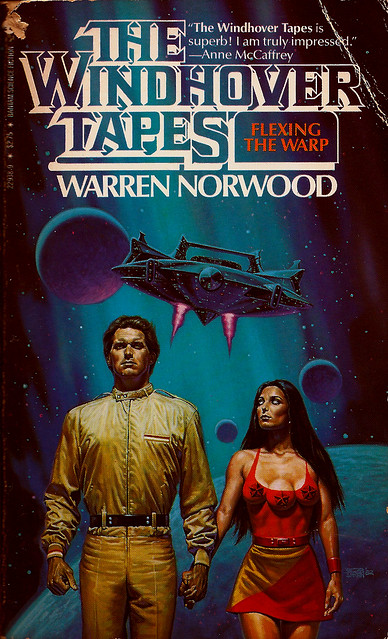
The story itself doesn't sound too bad. Part of a series, this particular one seems to focus on "diplomatic troubleshooter" Gerard Manley as he tries to uncover an ancient legend. Plus it answers the question everyone's had on their minds since the dawn of time: how do we make a buxom space maiden even more inappropriately sexy? You give her a third breast.
Excelsior
Tuesday, August 30, 2011
Goodbye, Borders
Yesterday I paid what will likely be my last visit to a Borders Books. Here's a typical shelf in their store:
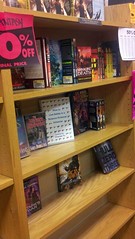
As you can see, things are about half-full, like some carcass partially picked over by a small flock of vultures. What's there is kind of in order, but not really. The staff seemed more interested in selling the tables and bookcases than in helping confused customers find books. And frankly, I don't blame them.
It was a melancholy experience for me. I grew up in the Virginia suburbs of Washington, D.C. Up through high school the only game in town were B. Dalton's and Waldenbooks. Nice stores for their day but pretty small in comparison to what we've become used to. I'm pretty sure the stores from my youth would only barely hold the regular fiction collection of a Borders or B&N, so when Borders first came to the area when I was in college it was like a revelation. And it wasn't just about size.
You mean you don't stick Sci-Fi into the darkest, loneliest corner of your store?
You mean you actually carry comics and graphic novels? Like on the shelf?
And you'll special order stuff for me and not sneer at me while you do it?
For the first time since I was a little kid I actually felt welcome in a bookstore. It was fantastic and I made a point to visit it every time I came home from college so I could stock up on pleasure reading for the semester.
As I've gotten (much) older and my tastes have changed I've found less and less by just browsing in their stores, but certainly more than I do when I browse their main competitor. Losing all of these stores will be a loss for many communities.

Take where I live: Prince George's County, Md. A suburb of Washington, D.C. Population of 863,420 and, according to Wikipedia, "the wealthiest African-American majority county in the nation". With the Borders stores closing, that sadly leaves all of two bookstores in the entire county. When the location in Landover shut down a few months ago it ended a series of weekly kids programs, teen book groups, adult book groups, an anime club, author readings, and a place many went just to read, write, and use their internet while sipping coffee. Say what you will about poor business decisions by corporate and ineffective competition, but around here I know book lovers will feel a real sense of loss when these stores shrivel up.
Excelsior
Subscribe to:
Posts (Atom)