This month has been all about adapting to new patterns. Aside from starting a new job with a very different work schedule than what I'm used to, I decided to go back to writing book reviews. I've been writing for the site No Flying No Tights, a site that reviews comics, manga and anime. It's written largely by and for librarians, but most of the reviews and articles are perfectly fine if you have any interest at all in comics and comics-related culture. They've put out four so far:
Surrogates, vol 1 and vol 2
BodyWorld
Witchfinder: In the Service of Angels
Biomega, vol 1 and vol 2 and vol 3
With more to come soon. Check them out and comment if you like.
After almost two years off, it's been a lot of fun writing reviews again. Even though I read all the time, the experience is so different when you have to think about something critically.
Sort of related, last night I downloaded the free trial version of the writing software Scrivener. I'm just starting to really play with it, but I'm really curious to see if it's as good a product as I keep hearing. More on that later (probably).
Excelsior
Monday, November 21, 2011


Friday, October 28, 2011
The Warhound and the World's Pain
The first stop on my long journey into Michael Moorcock's Eternal Champion saga is his short novel. The War Hound and the World's Pain. Although written more than a decade after the first Elric novel, Moorcock himself now suggests it and the following books in the Von Bek series as the best starting point for getting a handle on the whole Eternal Champion thing.
The main character (I hesitate to use the word hero for any Moorcock book) is Ulrich von Bek. Son of a learned nobleman, he rejected his father and family by first becoming a soldier and, later on, a mercenary for hire. The novel opens towards the end of the Thirty Years War, with Europe in general and Germany in particular largely torn apart by the long, violent clash between nations. Ulrich (whose similarity in name to Elric is certainly purposeful) is battle-weary at this point. We see him travelling across a devastated landscape looking for temporary sanctuary before joining yet another conflict.
Ulrich stumbles across an ancient castle. Lacking any guards, he first thinks it empty and helps himself to a nice bed and some food. But it isn’t long before he discovers Sabrina, a beautiful raven-haired woman he instantly falls for. After a wild night of debauchery, Sabrina openly admits to being a slave for Lucifer and that she’s being used to help arrange a meeting between Ulrich and her master. Ulrich thinks Sabrina, despite her intelligence and beauty, might be a bit crazy. Or at least her master might be. Curious, he decides to play along to see what will happen.
The Lucifer he meets, as it turns out, is quite real. But this Lucifer is not the stereotypical fire-and-brimstone devil. There’s no pitchfork, no horns, no tail. Ulrich walks into the fallen angel’s private study and finds “Seated at the table and apparently reading a book...the most wonderful being I had ever seen. I became light-headed. My body refused any commands. I found myself bowing” (34). This description sits closer to the descriptions we see of Angels in the Bible than it does to the stereotypical descriptions of demons and devils. Which makes sense since Lucifer is, after all, an Angel God kicked out of heaven. The portrayal here reminds me of Lucifer as Neil Gaiman portrays him in his Sandman series, and, of course Mike Carey’s spinoff comic book series Lucifer. It would not surprise me to find out that this novel was an influence on both writers. Lucifer has a deal for Ulrich.
Since Ulrich has spent most of his life bringing war to the world, Ulrich’s soul belongs fully to Lucifer. The fallen angel vows to release Ulrich’s soul on the condition that Ulrich locate the Holy Grail. Lucifer believes it to hold the secret to the cure for the world’s pain and through its use hopes to both bring mankind eternal happiness and reclaim his own place in heaven at God’s side. Despite the being’s obvious power, Ulrich remains dubious that this could be the one and only Lucifer. So the demon takes the warrior on a whilrwind tour of hell, showing him everything from bored spirits to tormented souls. Ulrich accepts Lucifer’s deal, on the one condition that Sabrina’s soul be released as well if he succeeds. The quest takes Ulrich across war-torn Europe and deep into forgotten mystical lands. Along the way he acquires a companion, a not-too-bright East European warrior named Sedenko who pledges his life to help Ulrich. He also meets Groot, a strange mystic who holds the key to the Grail’s location. These two very different companions represent two different ways of looking at the world---Sedenko’s being filled with supersition and mistrust while Groot holds tight to ideas of mysticism and idealism. The two of them have several disagreements throughout the tale. Discouraged about there progress, at one point Ulrich asks, “What’s the use?”
Groot replies, “Because we are alive, I suppose, Captain von Bek. Because we have no choice but to hope to make it better, through our own designs.” “The world is the world,” said Sedenko. “We cannot change it. That is for God to do”.“Perhaps he thinks it is for us to do,” said Groot quietly. 156
This last line is key to the ideas of free will and taking responsibility, two of the great themes of this book.
The main character (I hesitate to use the word hero for any Moorcock book) is Ulrich von Bek. Son of a learned nobleman, he rejected his father and family by first becoming a soldier and, later on, a mercenary for hire. The novel opens towards the end of the Thirty Years War, with Europe in general and Germany in particular largely torn apart by the long, violent clash between nations. Ulrich (whose similarity in name to Elric is certainly purposeful) is battle-weary at this point. We see him travelling across a devastated landscape looking for temporary sanctuary before joining yet another conflict.
Ulrich stumbles across an ancient castle. Lacking any guards, he first thinks it empty and helps himself to a nice bed and some food. But it isn’t long before he discovers Sabrina, a beautiful raven-haired woman he instantly falls for. After a wild night of debauchery, Sabrina openly admits to being a slave for Lucifer and that she’s being used to help arrange a meeting between Ulrich and her master. Ulrich thinks Sabrina, despite her intelligence and beauty, might be a bit crazy. Or at least her master might be. Curious, he decides to play along to see what will happen.
The Lucifer he meets, as it turns out, is quite real. But this Lucifer is not the stereotypical fire-and-brimstone devil. There’s no pitchfork, no horns, no tail. Ulrich walks into the fallen angel’s private study and finds “Seated at the table and apparently reading a book...the most wonderful being I had ever seen. I became light-headed. My body refused any commands. I found myself bowing” (34). This description sits closer to the descriptions we see of Angels in the Bible than it does to the stereotypical descriptions of demons and devils. Which makes sense since Lucifer is, after all, an Angel God kicked out of heaven. The portrayal here reminds me of Lucifer as Neil Gaiman portrays him in his Sandman series, and, of course Mike Carey’s spinoff comic book series Lucifer. It would not surprise me to find out that this novel was an influence on both writers. Lucifer has a deal for Ulrich.
Since Ulrich has spent most of his life bringing war to the world, Ulrich’s soul belongs fully to Lucifer. The fallen angel vows to release Ulrich’s soul on the condition that Ulrich locate the Holy Grail. Lucifer believes it to hold the secret to the cure for the world’s pain and through its use hopes to both bring mankind eternal happiness and reclaim his own place in heaven at God’s side. Despite the being’s obvious power, Ulrich remains dubious that this could be the one and only Lucifer. So the demon takes the warrior on a whilrwind tour of hell, showing him everything from bored spirits to tormented souls. Ulrich accepts Lucifer’s deal, on the one condition that Sabrina’s soul be released as well if he succeeds. The quest takes Ulrich across war-torn Europe and deep into forgotten mystical lands. Along the way he acquires a companion, a not-too-bright East European warrior named Sedenko who pledges his life to help Ulrich. He also meets Groot, a strange mystic who holds the key to the Grail’s location. These two very different companions represent two different ways of looking at the world---Sedenko’s being filled with supersition and mistrust while Groot holds tight to ideas of mysticism and idealism. The two of them have several disagreements throughout the tale. Discouraged about there progress, at one point Ulrich asks, “What’s the use?”
Groot replies, “Because we are alive, I suppose, Captain von Bek. Because we have no choice but to hope to make it better, through our own designs.” “The world is the world,” said Sedenko. “We cannot change it. That is for God to do”.“Perhaps he thinks it is for us to do,” said Groot quietly. 156
This last line is key to the ideas of free will and taking responsibility, two of the great themes of this book.

But this is also an adventure story, and what would an adventure be without a villain? Early in his journey Ulrich meets a man named Klosterheim. A former valiant knight who also once sought the grail, Klosterheim now serves a demon of hell hoping to take advantage of Lucifer’s failure and usurp control of both Hell and Earth. Groot tells us:
...should Lucifer be defeated, there will be a wild carelessness come upon Creation and it will be the end of the world, indeed. There will be no single Anti-Christ, though Klosterheim could be said to represent them all. There will be open warfare, in every region, between Heaven and Hell. It will be Armageddon, gentlemen, as has been predicted. Mankind will perish. And I believe, no matter what the Christian Bible predicts, that the outcome will be uncertain. 151
When Ulrich first meets Klosterheim he is little more than a gang-leader controlling a handful of vagabonds. But by the end he is a true threat, reigning over a vast army of men, demons and undead eager to stop Ulrich from fulfilling his quest. Because this is a heroic tale Ulrich does ultimately find the Grail and sees it for what it is---a simple clay pot. In a final confrontation between himself and Klosterheim, Ulrich holds the Grail out towards Klosterheim’s blood-hungry horde.
I held the Grail up high. No shining came out of it. No music came out if it. No great event took place. It remained what it was: a small clay pot.Yet, here and there in the ranks of Hell, pairs of eyes became transfixed. The looked. And a certain sort of peace came upon the faces of those who looked....They were falling to their knees. The were dismounting from their beasts. Even the most grotesque of them was transfixed by the clay pot. 175-176
The evil warriors defeated, Ulrich travels back to the castle to give the Grail to Lucifer and end his quest. Ulrich finds Lucifer not a champion but a being given a new task.
I am charged to bring Reason and Humanity into the world and thus discover a Cure for the World’s Pain. I am charged to understand the nature of this cup. When I understand its nature and mankind understands its nature, we shall both be redeemed...Your destiny is yours. Your lives are your own....You are at the beginning of a new age for Man. Man, whether he be Christian or pagan, must learn to rule himself, to understand himself, to take responsibility for himself. There can be no Armageddon now. If Man is destroyed, he shall have destroyed himself.
So we are to live without aid? Sabrina asks.
“And without hindrance," Lucifer replied. 180
Like all great stories, while the tale of Ulrich ends here it plants the seeds for another story. At this ending I couldn’t help but think what would come next of humanity and I see with interest that the next volume in the series takes place in Europe in the late 1700’s----after the influence of the Age of Reason stirred populations in colonial America and Europe to revolt against the long-held power of the royal families .
Overall the book is a mix of (sometimes heavy-handed) philosophy and action, so basically I loved it. It explores some high-minded thoughts you don’t always see in fantasy---or even traditional fiction----very often. I was also quite surprised by how much I liked Ulrich as a character. While Elric with his constant hand-wringing and wanting to change the established order is certainly a interesting I can’t say I’ve ever liked him. Ulrich, on the other hand, is a man of action but smart enough to think about beforehand. He’s a good leader but also willing do the hard-work and also sit down, have a beer and get to know his men. Much more interesting and rich a character. Since the next two books look at other generations of his family I’ll be especially interested to see what they are like and how this will tie into the whole Eternal Champions thing.
Next up: Book II in the Von Bek Cycle: The City in the Autumn Stars
Excelsior
Monday, September 26, 2011
Baltimore Book Festival
Yesterday my wife Lauren and I spent the afternoon at the Baltimore Book Festival. We were there largely for Lauren, because she had the first official signing for her new book Wicked Baltimore. Here she is signing it for one of her new fans:

If you have any interest in Baltimore/Maryland history, or you just like reading about the dark corners you don't normally get in history books, it's a fun read covering everything from Poe to political riots to grave robbing. Check out her own site for more info.
I did a lot of wandering around while Lauren was signing and selling copies. The Science Fiction and Fantasy Writers Association had a small tent there that featured readings and sold books by some local members as well as some fun games. The Maryland Writer's Association also had a nice little tent, which featured among other things a nice announcement from the Baltimore Review. They're re-launching their literary journal but as an online-only product. They seem to hope it will allow them to publish a greater number of authors and highlight them in different ways. I wish them luck with the venture and may even send them something soon.
I also spent a lot of time at the Radical Books Pavilion. Sponsored by Red Emma's, a Baltimore Bookstore and coffee shop that focuses on "radical politics", I was intrigued even if a lot of the material and other people there made me feel like a crazy right winger. I took in a really interesting talk by Dean Spade, a lawyer and law professor from Seattle who is a big spokesperson and advocate for gender, sexual and transgender politics. I have to admit I came not being at all familiar with Spade, but he's a definite rock star in his world. He spoke largely about the ineffectiveness of focusing on legal aspects like forcing the adoption of hate crime legislation and suggested that more locally-based pressures are required to create real change. It's not a world I know a lot about but I found it pretty eye-opening and couldn't help but wonder what, if anything, I can do in my position as a librarian in a moderate/liberal but fairly comfortable part of the country.
Excelsior
Friday, September 16, 2011
Rant: Mark Millar's Trouble
There was a lot of hand-wringing and anger when Mark Millar's Trouble first came out a few years ago....some of it justified, mostly not. People were angry because:
1. The covers featured photos, not the usual drawings, of girls that look like teen girls acting sexy. Although I understand the criticism the photos are less racy than any fashion magazine and, really, than the art in a lot of superhero comics. Plus I think they were going for the whole Gossip Girl crowd.
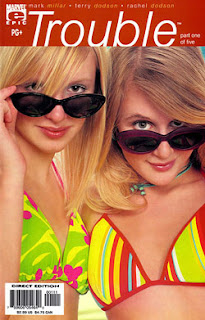
2. The story features teenagers in the early 1960's having (gasp!) sex! Sure, you can call this a bit exploitative but let's face. Teens have sex. Or at least a lot of them do. Plus if you bother to read to the ending you'll see their sexual activities end up having real consequences (pregnancy, hurt feelings, loss of opportunities in life) that they are left to deal with for the rest of their lives.
3. I think the real reason comics fans reacted so strongly to this is because Millar made this a complicated love mixup romance between May, her friend Mary, Ben and his brother Richard. If those names are familiar to you it's because they are the same names as Peter Parker's (you know, Spider-man) parents and Aunt May and Uncle Ben. Essentially, May cheats on her boyfriend Ben and gets pregnant by Richard, who is Mary's girlfriend. For reasons not worth getting into here friend Mary decides to lie for May and take the child for her own. So not only does it portray Peter Parker's nice old aunt as being a tramp in her teenage years, it also sets her up as his real mother, which all pretty much smacks comic lore right in face. And there's no way to get the ire of the comic book world faster than to write a story that even suggests something different than the known canon of superhero lore. Honestly, I thought it was kind of funny.
Don't get me wrong. This is not a great graphic novel/comic book series. It's an entertaining older teen romance story and it reminds me of a lot of the half-baked romance/comedies I grew up with in the 80's like The Flamingo Kid, but it's nowhere near bad. If you want to hate a series, fanboys, get over yourselves and at least hate it for the right reasons.
Excelsior.
1. The covers featured photos, not the usual drawings, of girls that look like teen girls acting sexy. Although I understand the criticism the photos are less racy than any fashion magazine and, really, than the art in a lot of superhero comics. Plus I think they were going for the whole Gossip Girl crowd.

2. The story features teenagers in the early 1960's having (gasp!) sex! Sure, you can call this a bit exploitative but let's face. Teens have sex. Or at least a lot of them do. Plus if you bother to read to the ending you'll see their sexual activities end up having real consequences (pregnancy, hurt feelings, loss of opportunities in life) that they are left to deal with for the rest of their lives.
3. I think the real reason comics fans reacted so strongly to this is because Millar made this a complicated love mixup romance between May, her friend Mary, Ben and his brother Richard. If those names are familiar to you it's because they are the same names as Peter Parker's (you know, Spider-man) parents and Aunt May and Uncle Ben. Essentially, May cheats on her boyfriend Ben and gets pregnant by Richard, who is Mary's girlfriend. For reasons not worth getting into here friend Mary decides to lie for May and take the child for her own. So not only does it portray Peter Parker's nice old aunt as being a tramp in her teenage years, it also sets her up as his real mother, which all pretty much smacks comic lore right in face. And there's no way to get the ire of the comic book world faster than to write a story that even suggests something different than the known canon of superhero lore. Honestly, I thought it was kind of funny.
Don't get me wrong. This is not a great graphic novel/comic book series. It's an entertaining older teen romance story and it reminds me of a lot of the half-baked romance/comedies I grew up with in the 80's like The Flamingo Kid, but it's nowhere near bad. If you want to hate a series, fanboys, get over yourselves and at least hate it for the right reasons.
Excelsior.
Saturday, September 10, 2011
Moorcock's Eternal Champions
During the onslaught of Hurricane Irene a couple of weeks ago, my wife and I did what a lot of people probably did. We huddled up together in our powerless house, turned on some flashlights and read a lot. Although I ploughed through a bunch of graphic novels I had sitting around, I also pulled the first volume of Michael Moorcock's Elric series, Elric of Melniboné out of my stuffed bookcase.

If you aren't familiar with Elric, the character is essentially Moorcock's response to the extreme popularity and reverence the world had at the time for Tolkien's Lord of the Rings saga. Elric is the last emperor of a stagnate civilzation known as Melnibone. Elric the Albino, as he is often called, is physically weak and supplements his health with a regimen of drugs and herbs. Unlike the rest of his people Elric holds a tiny sliver of regret for the decadence his empire enjoys and sees it as a sign of the end of their generations-long rule. This makes him unpopular and a target by his family members who seek to end his life and steal his political power for themselves. To survive, Elric sets out on a quest for the magic sword Stormbringer, a powerful magic weapon that lives off the souls of any it strikes down.
The Elric books were first recomended to me back in high school. A friend at the time loaned me the first one; I remember taking it home, starting it after dinner and reading it straight through until 5 AM the next morning. Even by today's standards Elric is such a different hero, for lack of a better term. He does reprehensible, horrible things, but he also continually questions what he does, why he does it and why the world is as it is. That existential twist sparked something in me, so I went on to devour the entire series.
A few years later, probably half-way through college, I read something somewhere that cited Elric as Moorcock's first piece in his complex Eternal Champions cycle....something only vaguley hinted at in the Elric books. As I understand it, which is not very well at all, the Eternal Champion is a kind of reincarnation of a poweful, pivotally important being. Sometimes they serve good. Sometimes evil. And sometimes something in-between. This concept runs through a lot, although not all, of Moorcock's fiction, showing up in fantasy, science fiction, psychelic spy satires, and more.
Unfortunately most of the dozens of books that fit into the cycle are out of print, so I've picked them up randomly over the years when I find them in used book stores. Which has made understanding the whole over-arching concept of the eternal champion a bit difficult. Re-reading Elric of Melniboné made me want to figure out the whole thing out so I visited Moorcock's own website to figure out a place to start. There, in the forums, is a listing of all the Eternal Champion's titles and the suggested order of reading.
Oddly enough, the most suggested starting place is not the Elric books but another series called Von Bek. Set much later in time, and written a decade later, it seems an odd place to dive in. But it was suggested by both readers and Moorcock himself as a place to get a real foothold in the crazy multiverse he's created. I have an old copy of the first volume, The War Hound and the World's Pain, sitting on my shelf right now. There are so many books that tie into Moorcock's Multiverse and the Eternal Champion that I'm probably setting myself up for failure. But we'll see if I can figure this thing out.
Excelsior

If you aren't familiar with Elric, the character is essentially Moorcock's response to the extreme popularity and reverence the world had at the time for Tolkien's Lord of the Rings saga. Elric is the last emperor of a stagnate civilzation known as Melnibone. Elric the Albino, as he is often called, is physically weak and supplements his health with a regimen of drugs and herbs. Unlike the rest of his people Elric holds a tiny sliver of regret for the decadence his empire enjoys and sees it as a sign of the end of their generations-long rule. This makes him unpopular and a target by his family members who seek to end his life and steal his political power for themselves. To survive, Elric sets out on a quest for the magic sword Stormbringer, a powerful magic weapon that lives off the souls of any it strikes down.
The Elric books were first recomended to me back in high school. A friend at the time loaned me the first one; I remember taking it home, starting it after dinner and reading it straight through until 5 AM the next morning. Even by today's standards Elric is such a different hero, for lack of a better term. He does reprehensible, horrible things, but he also continually questions what he does, why he does it and why the world is as it is. That existential twist sparked something in me, so I went on to devour the entire series.
A few years later, probably half-way through college, I read something somewhere that cited Elric as Moorcock's first piece in his complex Eternal Champions cycle....something only vaguley hinted at in the Elric books. As I understand it, which is not very well at all, the Eternal Champion is a kind of reincarnation of a poweful, pivotally important being. Sometimes they serve good. Sometimes evil. And sometimes something in-between. This concept runs through a lot, although not all, of Moorcock's fiction, showing up in fantasy, science fiction, psychelic spy satires, and more.
Unfortunately most of the dozens of books that fit into the cycle are out of print, so I've picked them up randomly over the years when I find them in used book stores. Which has made understanding the whole over-arching concept of the eternal champion a bit difficult. Re-reading Elric of Melniboné made me want to figure out the whole thing out so I visited Moorcock's own website to figure out a place to start. There, in the forums, is a listing of all the Eternal Champion's titles and the suggested order of reading.
Oddly enough, the most suggested starting place is not the Elric books but another series called Von Bek. Set much later in time, and written a decade later, it seems an odd place to dive in. But it was suggested by both readers and Moorcock himself as a place to get a real foothold in the crazy multiverse he's created. I have an old copy of the first volume, The War Hound and the World's Pain, sitting on my shelf right now. There are so many books that tie into Moorcock's Multiverse and the Eternal Champion that I'm probably setting myself up for failure. But we'll see if I can figure this thing out.
Excelsior
Friday, September 02, 2011
Judging by the Cover: The Windhover Tapes
I have a rather odd love of old book cover art, particularly sci-fi and fantasy book cover art because it has such a tendency to go completely crazy. I'll often pick up old books in the booksale at my library solely because of a crazy or really bad cover. This week I picked up a 1983 novel by Warren Norwood entitled The Windhover Tapes: Flexing the Warp.

The story itself doesn't sound too bad. Part of a series, this particular one seems to focus on "diplomatic troubleshooter" Gerard Manley as he tries to uncover an ancient legend. Plus it answers the question everyone's had on their minds since the dawn of time: how do we make a buxom space maiden even more inappropriately sexy? You give her a third breast.
Excelsior
Tuesday, August 30, 2011
Goodbye, Borders
Yesterday I paid what will likely be my last visit to a Borders Books. Here's a typical shelf in their store:

As you can see, things are about half-full, like some carcass partially picked over by a small flock of vultures. What's there is kind of in order, but not really. The staff seemed more interested in selling the tables and bookcases than in helping confused customers find books. And frankly, I don't blame them.
It was a melancholy experience for me. I grew up in the Virginia suburbs of Washington, D.C. Up through high school the only game in town were B. Dalton's and Waldenbooks. Nice stores for their day but pretty small in comparison to what we've become used to. I'm pretty sure the stores from my youth would only barely hold the regular fiction collection of a Borders or B&N, so when Borders first came to the area when I was in college it was like a revelation. And it wasn't just about size.
You mean you don't stick Sci-Fi into the darkest, loneliest corner of your store?
You mean you actually carry comics and graphic novels? Like on the shelf?
And you'll special order stuff for me and not sneer at me while you do it?
For the first time since I was a little kid I actually felt welcome in a bookstore. It was fantastic and I made a point to visit it every time I came home from college so I could stock up on pleasure reading for the semester.
As I've gotten (much) older and my tastes have changed I've found less and less by just browsing in their stores, but certainly more than I do when I browse their main competitor. Losing all of these stores will be a loss for many communities.

Take where I live: Prince George's County, Md. A suburb of Washington, D.C. Population of 863,420 and, according to Wikipedia, "the wealthiest African-American majority county in the nation". With the Borders stores closing, that sadly leaves all of two bookstores in the entire county. When the location in Landover shut down a few months ago it ended a series of weekly kids programs, teen book groups, adult book groups, an anime club, author readings, and a place many went just to read, write, and use their internet while sipping coffee. Say what you will about poor business decisions by corporate and ineffective competition, but around here I know book lovers will feel a real sense of loss when these stores shrivel up.
Excelsior
Saturday, August 27, 2011
This past week I read a new book---actually new to English readers----put out by Top Shelf called Lucille. Written and drawn by french cartoonist Ludovic Debeurme, Lucille looks at the lives of two teenagers as they both struggle with very difficult situations. For reasons that are explored quite well in the book but I won’t go into here, Lucille herself is severely depressed and an anorexic. Arthur faces all kind of complicated emotions, since he was the final albeit unintentional catalyst that caused his father to lose his job as a fisherman and take his own life. Arthur and Lucille meet randomly, join forces and set out on the road together on a European tour, forcing them to discover themselves, discover one another and confront many of the issues they’ve kept bottled up for so long.
This little rant isn’t so much a review as it is a discussion with myself over some of the difficulties I sometimes struggle with when it comes to teen-oriented graphic novels. As far as topic and theme, Lucille is a fantastic book for teens. It explores some very difficult issues but in a manner that’s personal, moving and, perhaps most important for a teen book, accessible. Debeurme’s artwork seems simple, maybe even crude, at first. But it matches quite well with the story and there are some images that stab you right in the heart.
But there are two scenes in the book that portray man-on-woman oral sex. It’s not overly graphic but it’s certainly obvious what’s going on. Personally I don’t have a problem with it. There’s a purpose to both scenes and they play powerfully into Lucille’s disturbed psychology in a way that anyone who’s experienced abuse of any kind will certainly understand. So while I would love to be able to hand this book to teens coming into my library, especially any struggling with issues like these, I know doing so would likely get me in a big heap of trouble solely because of these two illustrations. Adapt this book to one of complete prose and fewer people would have any issue with the book. Heck, find a way to take out those two scenes without cutting the power of the book (which I don’t think is possible) and people would have a hard time arguing against this book in any way.To be fair, Top Shelf isn’t marketing this as a Young Adult/Teen book. And I don’t know that the creator intended it to be one, either. I don’t have an answer here, it’s just something I’m struggling with right now.
Excelsior
 teenagers as they both struggle with very difficult situations. For reasons that are explored quite well in the book but I won’t go into here, Lucille herself is severely depressed and an anorexic. Arthur faces all kind of complicated emotions, since he was the final albeit unintentional catalyst that caused his father to lose his job as a fisherman and take his own life. Arthur and Lucille meet randomly, join forces and set out on the road together on a European tour, forcing them to discover themselves, discover one another and confront many of the issues they’ve kept bottled up for so long.
This little rant isn’t so much a review as it is a discussion with myself over some of the difficulties I sometimes struggle with when it comes to teen-oriented graphic novels. As far as topic and theme, Lucille is a fantastic book for teens. It explores some very difficult issues but in a manner that’s personal, moving and, perhaps most important for a teen book, accessible. Debeurme’s artwork seems simple, maybe even crude, at first. But it matches quite well with the story and there are some images that stab you right in the heart.

But there are two scenes in the book that portray man-on-woman oral sex. It’s not overly graphic but it’s certainly obvious what’s going on. Personally I don’t have a problem with it. There’s a purpose to both scenes and they play powerfully into Lucille’s disturbed psychology in a way that anyone who’s experienced abuse of any kind will certainly understand. So while I would love to be able to hand this book to teens coming into my library, especially any struggling with issues like these, I know doing so would likely get me in a big heap of trouble solely because of these two illustrations. Adapt this book to one of complete prose and fewer people would have any issue with the book. Heck, find a way to take out those two scenes without cutting the power of the book (which I don’t think is possible) and people would have a hard time arguing against this book in any way.To be fair, Top Shelf isn’t marketing this as a Young Adult/Teen book. And I don’t know that the creator intended it to be one, either. I don’t have an answer here, it’s just something I’m struggling with right now.
Excelsior
Saturday, May 28, 2011
Research: When It's Time to Dig In
We've all seen them. Those legal thrillers or crime shows where the hero just can't find the one single detail that ties everything all together. And then they go to the library, sit down at a public computer, open up a search engine and, after a few quick keystrokes, find the answer that leads them to the villain, the secret lair, the unknown weakness and the pot-o-gold at the end of the rainbow. But research is rarely that easy.
I just finished the first draft for personal essay/memoir kind of thing. Although it's mostly based on things that happened to me, there are a couple of fine details I want to research and nail down before I even think about sending this thing out. One of them being the date of a concert I went to in the mid 1990's. I know the year. And it was snowing that night, so I know it was sometime between November and March. But beyond that I really don't remember.
So I spent a couple of hours digging through the electronic databases at work, accessing The Washington Post as well as some more local papers, looking for any mention of the specific concert tour. It wasn't a major stadium tour, but at the 9:30 Club in D.C. Not the current super-warehouse space, but the old, dingy bar near the Metro Center metro stop (oh how I miss that dirty place). I couldn’t find anything, so it became apparent that it wasn't a show Mark Jenkins or one of the other critics reviewed. But I thought I'd still find it listed in an events guide in old weekend sections or something. But the databases don't seem to capture any of that stuff----just the actual articles. In the end, I think I'll have to trek out to the one library in my library system that still has old issues of The Washington Post on microfiche, and go through the weekend sections week-by-week until I find what I need.
I was at writing conference once and heard Karey Joy Fowler talk about her process and how one of the greatest tools for her in writing historical fiction is going through the advertisements and personal ads to get a sense of the language, what people bought, ate and did for fun. Details like that are still getting left out with most of our digital tools. It just points out to me some of the limitations of using digital sources for research. They can be a wonderful time saver if they have what you want, but for those pieces that are a little more esoteric----and those are often the pieces that are the most fun-----you still have to get your hands dirty flipping through physical newspapers, magazines and microfiche.
Excelsior
I just finished the first draft for personal essay/memoir kind of thing. Although it's mostly based on things that happened to me, there are a couple of fine details I want to research and nail down before I even think about sending this thing out. One of them being the date of a concert I went to in the mid 1990's. I know the year. And it was snowing that night, so I know it was sometime between November and March. But beyond that I really don't remember.
So I spent a couple of hours digging through the electronic databases at work, accessing The Washington Post as well as some more local papers, looking for any mention of the specific concert tour. It wasn't a major stadium tour, but at the 9:30 Club in D.C. Not the current super-warehouse space, but the old, dingy bar near the Metro Center metro stop (oh how I miss that dirty place). I couldn’t find anything, so it became apparent that it wasn't a show Mark Jenkins or one of the other critics reviewed. But I thought I'd still find it listed in an events guide in old weekend sections or something. But the databases don't seem to capture any of that stuff----just the actual articles. In the end, I think I'll have to trek out to the one library in my library system that still has old issues of The Washington Post on microfiche, and go through the weekend sections week-by-week until I find what I need.
I was at writing conference once and heard Karey Joy Fowler talk about her process and how one of the greatest tools for her in writing historical fiction is going through the advertisements and personal ads to get a sense of the language, what people bought, ate and did for fun. Details like that are still getting left out with most of our digital tools. It just points out to me some of the limitations of using digital sources for research. They can be a wonderful time saver if they have what you want, but for those pieces that are a little more esoteric----and those are often the pieces that are the most fun-----you still have to get your hands dirty flipping through physical newspapers, magazines and microfiche.
Excelsior
Wednesday, May 11, 2011
How To Live Safely in a Science Fictional Universe
I took me a little longer than it should have, but I finally finished reading Charles Yu's How to Live Safely in a Science Fictional Universe.
Most of the reviews I've seen have focused on the humor and Yu's similarities to Douglas Adams. And while Adams is certainly in this book, I think a stronger influence might be Italo Calvino. A Calvino raised on a steady diet of Star Trek, Star Wars, Heinlein and X-Men comic books, but Calvino nonetheless. The following paragraphs from the book really sum up my thoughts on it:
Time travel was supposed to be fun, it was supposed to be about going to places and having a bunch of adventures. Not hovering over scenes from your own life as a detached observer. Not just lurching from moment to random moment, and never even learning about those moments. (401)
Get back in the box. Set it for home, present day. Go see your mom. Bring your dad. Have dinner, the three of you. Go find The Woman You Never Married and see if she might want to be The Woman You Are Going to Marry Someday. Step out of this box. Pop open the hatch. The forces within the chronohydraulic air lock will equalize. Step out into the world of time and risk and loss again. Move forward, into the empty plane. Find the book you wrote, and read it until the end, but don't turn the last page yet, keep stalling, see how long you can keep expanding the infinitely expandable moment. Enjoy the elastic present, which can accommodate as little or as much as you want to put in there. Stretch it out, live inside it. (459)
I read this as an Ebook through my Ipod touch. The book is filled with footnotes, diagrams and pictures that go along with the narrative. Now these aren't directly in the text, but presented to the reader as an optional hyperlink you can open by pressing with your finger. I've seen the footnote thing with non-fiction titles, but this is the first fiction title I've seen use the Ebook format in this way. Yu even takes an extra step by giving a link to a Youtube video demonstrating a brain experiment on how the human brain acts when it makes specific choices.
A small lightbulb went off in my little brain on how most of this isn't possible in your standard Ereader; it requires a tablet, cell phone or other web-ready device that can handle something more than B&W text and simple pictures. The whole experience reminded me a little of the web-based Hyperfiction texts you'd find at places like Alt-X in the mid to late 90's. It's kind of exciting and I'm really curious to see what a writer with a real formalist/expermentalist bent like Danielewski could do with a tool like an Ereader.
Excelsior
Most of the reviews I've seen have focused on the humor and Yu's similarities to Douglas Adams. And while Adams is certainly in this book, I think a stronger influence might be Italo Calvino. A Calvino raised on a steady diet of Star Trek, Star Wars, Heinlein and X-Men comic books, but Calvino nonetheless. The following paragraphs from the book really sum up my thoughts on it:
Time travel was supposed to be fun, it was supposed to be about going to places and having a bunch of adventures. Not hovering over scenes from your own life as a detached observer. Not just lurching from moment to random moment, and never even learning about those moments. (401)
Get back in the box. Set it for home, present day. Go see your mom. Bring your dad. Have dinner, the three of you. Go find The Woman You Never Married and see if she might want to be The Woman You Are Going to Marry Someday. Step out of this box. Pop open the hatch. The forces within the chronohydraulic air lock will equalize. Step out into the world of time and risk and loss again. Move forward, into the empty plane. Find the book you wrote, and read it until the end, but don't turn the last page yet, keep stalling, see how long you can keep expanding the infinitely expandable moment. Enjoy the elastic present, which can accommodate as little or as much as you want to put in there. Stretch it out, live inside it. (459)
I read this as an Ebook through my Ipod touch. The book is filled with footnotes, diagrams and pictures that go along with the narrative. Now these aren't directly in the text, but presented to the reader as an optional hyperlink you can open by pressing with your finger. I've seen the footnote thing with non-fiction titles, but this is the first fiction title I've seen use the Ebook format in this way. Yu even takes an extra step by giving a link to a Youtube video demonstrating a brain experiment on how the human brain acts when it makes specific choices.
A small lightbulb went off in my little brain on how most of this isn't possible in your standard Ereader; it requires a tablet, cell phone or other web-ready device that can handle something more than B&W text and simple pictures. The whole experience reminded me a little of the web-based Hyperfiction texts you'd find at places like Alt-X in the mid to late 90's. It's kind of exciting and I'm really curious to see what a writer with a real formalist/expermentalist bent like Danielewski could do with a tool like an Ereader.
Excelsior
Tuesday, April 26, 2011
Philip K Dick Awards
The winner for this year's Philip K. Dick Award----distinguished original science fiction paperback----was picked over the weekend. Odd to me, because the winner is the only one on the list of nominees I've managed to read thus far. Well deserved, though. Mark Hodder tells a great story with The Strange Affair of Spring-Heeled Jack and it's easily one of the better steampunk titles I've read in recent years, mostly because of how great a character Sir Richard Burton becomes under Hodder's pen.
I'll need to buckle down and read the others---for whatever reason my tastes tend to lean more towards the PKD Awards than with the other Sci Fi and Fantasy awards. Harmony by Project Itoh sounds particularly fun.
Excelsior
I'll need to buckle down and read the others---for whatever reason my tastes tend to lean more towards the PKD Awards than with the other Sci Fi and Fantasy awards. Harmony by Project Itoh sounds particularly fun.
Excelsior
Friday, April 22, 2011
Interview with Jesse Karp
One of my cool side-gigs is doing a lot of things with the professional association YALSA (Young Adult Library Services Association), and one of the things I do for them is manage a semi-regular Podcast. A lot of them end up being YALSA-business kinds of interviews, but this past week was a fun one. I interviewed Jesse Karp about his first published novel, a dark and mind-bending SpecFic book called Those That Wake. For more about Jesse, check out his own site Beyond Where You Stand.
Saturday, February 27, 2010
A New Direction
So I've been slacking on the blog here for the last couple of months, not because I haven't been reading or writing but because I've been putting reviews I normally do up on another site, Murmur.com. The literature community there is small but growing, and it's nice to get feedback from other people who are reading some of the same things I read.
But one of my New Year's resolutions this year was to read all the published books by Gene Wolfe, in the order they were published. If you aren't familiar with Wolfe he's up there as one of the more literary writers in Fantasy and SF; while I've really enjoyed what I've read of his work I've barely scratched the surface of his output. To help keep me going, I've decided to write up reactions and reviews of sorts and share those here. Since a lot of the books are older I think it will work better in this space.
A number of his books, especially his early ones, are long out of print so there may be some stretches of time in-between titles as I track them down. Who knows...I might share the woes of searching for hard-to-find titles as well as reviews. We'll see how it goes. But first up is Wolfe's first published novel Operation: Ares. I've finished reading it and should have my thoughts fully together within a day or two. Until then...
Excelsior
But one of my New Year's resolutions this year was to read all the published books by Gene Wolfe, in the order they were published. If you aren't familiar with Wolfe he's up there as one of the more literary writers in Fantasy and SF; while I've really enjoyed what I've read of his work I've barely scratched the surface of his output. To help keep me going, I've decided to write up reactions and reviews of sorts and share those here. Since a lot of the books are older I think it will work better in this space.
A number of his books, especially his early ones, are long out of print so there may be some stretches of time in-between titles as I track them down. Who knows...I might share the woes of searching for hard-to-find titles as well as reviews. We'll see how it goes. But first up is Wolfe's first published novel Operation: Ares. I've finished reading it and should have my thoughts fully together within a day or two. Until then...
Excelsior
Thursday, October 22, 2009
What's Up, Google Docs!
I've been doing a lot of research lately for a number of writing projects, but things often get waylaid when the wife usurps the laptop. My normal research process is to bury myself in a subject; I read, read read and take notes on the computer as I go. Whether I'm looking up biographical details about the jazz musician Sun Ra or exploring different ways to describe what happens when an object falls into a black hole, it's a method that works for me so I can get those odd, salient details into a piece.
Even though it's our laptop now, it was my laptop before we got married. So most of my writing files are on there and, frankly, I'm just used to keeping them there. And while we have a desktop computer as well the laptop is often just the most convenient one to jump onto.
Walking the dog tonight, a solution occurred to me: google docs. I've used it before for group coursework in library school and even for some projects I've worked on for YALSA. But never just for myself. Surprising I never thought of it before now, because it is so damn easy to use. Either upload your documents or work on it right there in the web-browser. The beauty of it is, I'll be able to save my work no matter what computer I use. Hell, I can even work on some things during my lunch time or other slow moments at work. I know, I know. This sounds like my account's been hacked by google...so to be fair, I know there are other document-sharing programs out there. This is just the one I've used and know how to use.
So, thanks to google docs, I have no more excuses for not writing. At least so long as we have at least two computers in our home. I guess I better get back to it.
Excelsior
Even though it's our laptop now, it was my laptop before we got married. So most of my writing files are on there and, frankly, I'm just used to keeping them there. And while we have a desktop computer as well the laptop is often just the most convenient one to jump onto.
Walking the dog tonight, a solution occurred to me: google docs. I've used it before for group coursework in library school and even for some projects I've worked on for YALSA. But never just for myself. Surprising I never thought of it before now, because it is so damn easy to use. Either upload your documents or work on it right there in the web-browser. The beauty of it is, I'll be able to save my work no matter what computer I use. Hell, I can even work on some things during my lunch time or other slow moments at work. I know, I know. This sounds like my account's been hacked by google...so to be fair, I know there are other document-sharing programs out there. This is just the one I've used and know how to use.
So, thanks to google docs, I have no more excuses for not writing. At least so long as we have at least two computers in our home. I guess I better get back to it.
Excelsior
Friday, September 25, 2009
Review: Peter & Max: A Fables Novel
I've been reading BIll Willingham for years, ever since he started putting out the second volume of his comic book series The Elementals back in the late 80's. Since that time he's created and written all the issues of Fables for Vertigo; with 12 Eisner wins, a Hugo nomination and a couple of awards from YALSA's best graphic novels for Young Adults Fables has been one of the more critically successful comic book series of the last decade. Willingham now steps into the world of straight prose with his first novel, a charming fantasy set in his Fables world titled Peter & Max.
For the uninitiated, the Fables series takes characters from fairy tales, folklore and other open properties and– referring to them all as "Fables" – forces them out of their Homeland, a mystical realm that sits parallel to our own. Peter & Max begins in modern Fabletown, a magical village hidden in New York City where many of the immortal Fables now live. Peter Piper---the same Peter who picked a peck of pickled peppers and challenged the great wolf---is warned that his older and very evil brother Max, aka the Pied Piper, has been causing major problems out in the world. Peter heads for Hamelin, Germany to challenge his brother and put a stop to Max's dark ways for good.
Readers then get a series of flashbacks that take things back to medieval times and set the stage for the final conflict. Fiercely jealous when their father gives the Piper family heirloom, a magical flute named Frost, to the younger Peter Max murders his own father and seeks out dark magical secrets to someday take Frost for his own. After wandering for months in the Black Forest Max meets a powerful witch who gives him his own magical flute, which he quickly dubs Fire. Max learns to use the powers of Fire, first using it to enact the his legendary theft of the children of Hamelin and later to spread disease, chaos and fear everywhere he travels. We also get some snippets of Peter's early life as a thief, as well as his marriage to the trained assassin Bo Peep. Yes, I said trained assassin Bo Peep. The flashbacks feed into a nice, albeit somewhat short, final clash between the brothers.
Fantasy readers new to Fables will get a nice a taste of Willingham’s rich and satisfying world while fans of the comic series will find themselves treated to cameo appearances by popular characters like Bigby (aka the Big Bad Wolf), the Beast and Peter’s wife, Bo Peep. Artist Steve Leialoha (Fables, New Mutants) contributes several black-and-white drawings that very smartly enhance the fairy tale feeling of story.
Unfortunately, the early chapters of the novel have some big problems. Readers are given a brief historical tour of Fabletown as Rose Red tracks down Peter Piper to tell him about his brother. These long sections sit mired within a quagmire of exposition explaining the extensive background of Willingham’s inventive world; all written in a faux-Brothers Grimm style they weigh down the early pages of the book and might scare away readers who need to be grabbed right away. While many of the details given are necessary, they would have worked more effectively had they been sprinkled and used throughout the wider narrative. Readers willing to dig past this slow section, though, will find an action-packed fantasy built around two absolutely captivating characters.
Excelsior

For the uninitiated, the Fables series takes characters from fairy tales, folklore and other open properties and– referring to them all as "Fables" – forces them out of their Homeland, a mystical realm that sits parallel to our own. Peter & Max begins in modern Fabletown, a magical village hidden in New York City where many of the immortal Fables now live. Peter Piper---the same Peter who picked a peck of pickled peppers and challenged the great wolf---is warned that his older and very evil brother Max, aka the Pied Piper, has been causing major problems out in the world. Peter heads for Hamelin, Germany to challenge his brother and put a stop to Max's dark ways for good.
Readers then get a series of flashbacks that take things back to medieval times and set the stage for the final conflict. Fiercely jealous when their father gives the Piper family heirloom, a magical flute named Frost, to the younger Peter Max murders his own father and seeks out dark magical secrets to someday take Frost for his own. After wandering for months in the Black Forest Max meets a powerful witch who gives him his own magical flute, which he quickly dubs Fire. Max learns to use the powers of Fire, first using it to enact the his legendary theft of the children of Hamelin and later to spread disease, chaos and fear everywhere he travels. We also get some snippets of Peter's early life as a thief, as well as his marriage to the trained assassin Bo Peep. Yes, I said trained assassin Bo Peep. The flashbacks feed into a nice, albeit somewhat short, final clash between the brothers.
Fantasy readers new to Fables will get a nice a taste of Willingham’s rich and satisfying world while fans of the comic series will find themselves treated to cameo appearances by popular characters like Bigby (aka the Big Bad Wolf), the Beast and Peter’s wife, Bo Peep. Artist Steve Leialoha (Fables, New Mutants) contributes several black-and-white drawings that very smartly enhance the fairy tale feeling of story.
Unfortunately, the early chapters of the novel have some big problems. Readers are given a brief historical tour of Fabletown as Rose Red tracks down Peter Piper to tell him about his brother. These long sections sit mired within a quagmire of exposition explaining the extensive background of Willingham’s inventive world; all written in a faux-Brothers Grimm style they weigh down the early pages of the book and might scare away readers who need to be grabbed right away. While many of the details given are necessary, they would have worked more effectively had they been sprinkled and used throughout the wider narrative. Readers willing to dig past this slow section, though, will find an action-packed fantasy built around two absolutely captivating characters.
Excelsior
Monday, September 07, 2009
Review: McSweeney's 31
The whole concept behind McSweeney's 31 is a pretty fun one: dig up some old forms of literature, toss the ideas to contemporary writers and see what they can come up with.
From an editorial standpoint, I really like the issue. They cover a real wide breadth of styles in a fairly short volume: whore dialogues, Nordic sagas, Socratic Dialogues, pantoums and so on. Each section gives an example, or part of an example for the longer forms, and includes footnotes and marginalia so readers will know what the hell is going on, both formally and culturally.
I don't know if it's because the poems are shorter and didn't have a chance to wear out the gimmick or that poets are just more used to playing with a variety of constraints, but by and large I thought the poets did a better job. From Tony Trigilio's pantoum "Jack Davis"----a wonderful piece on the JFK assasination----to Chris Spurr's funny senryu they are all really strong. The narrative work, by and large, seems to peter out once they get ahold of the form.
But I don't want to make this a bitch session; there were some narrative pieces I liked. Douglas Coupland was a phenomenal choice to play with the Chinese form called Biji. Like a lot of Coupland's normal work "Surrender" mixes narrative, odd facts and rumors into a whole that's both timeless and postmodern. Add to it that it's a parody of reality television, and you have a piece that's not just an experiment in form but also a fun piece of cultural criticism.
David Thomson's stab at Socratic Dialogue by creating a hilarious and philosophical argument between Susan Sontag, Virginia Woolf, Charlie Chaplin and Ernest Hemingway is also fantastic, especially if you have a handle on film criticism. I also wasn't surprised to enjoy Shelley Jackson's take on the Conseutudinary, a unique type of writing for monks that includes instructions on day-to-day activities and religious thought. Jackson's version entitled "Conseutudinary of the Word Church, or the Church of the Dead Letter" is a deep but disturbing examination of semiotics, religion, philosophy and power.
All in all, a fun issue. I look forward to the next one.
Excelsior
From an editorial standpoint, I really like the issue. They cover a real wide breadth of styles in a fairly short volume: whore dialogues, Nordic sagas, Socratic Dialogues, pantoums and so on. Each section gives an example, or part of an example for the longer forms, and includes footnotes and marginalia so readers will know what the hell is going on, both formally and culturally.

I don't know if it's because the poems are shorter and didn't have a chance to wear out the gimmick or that poets are just more used to playing with a variety of constraints, but by and large I thought the poets did a better job. From Tony Trigilio's pantoum "Jack Davis"----a wonderful piece on the JFK assasination----to Chris Spurr's funny senryu they are all really strong. The narrative work, by and large, seems to peter out once they get ahold of the form.
But I don't want to make this a bitch session; there were some narrative pieces I liked. Douglas Coupland was a phenomenal choice to play with the Chinese form called Biji. Like a lot of Coupland's normal work "Surrender" mixes narrative, odd facts and rumors into a whole that's both timeless and postmodern. Add to it that it's a parody of reality television, and you have a piece that's not just an experiment in form but also a fun piece of cultural criticism.
David Thomson's stab at Socratic Dialogue by creating a hilarious and philosophical argument between Susan Sontag, Virginia Woolf, Charlie Chaplin and Ernest Hemingway is also fantastic, especially if you have a handle on film criticism. I also wasn't surprised to enjoy Shelley Jackson's take on the Conseutudinary, a unique type of writing for monks that includes instructions on day-to-day activities and religious thought. Jackson's version entitled "Conseutudinary of the Word Church, or the Church of the Dead Letter" is a deep but disturbing examination of semiotics, religion, philosophy and power.
All in all, a fun issue. I look forward to the next one.
Excelsior
Thursday, September 03, 2009
Miss L and I are back from our trip through Alaska and Canada, but I will have to write about that stuff later on. Instead this is about something that happened on Monday night, right after we got home. As a warning, although not graphic this post is a bit morbid.
I took our dog Echo out for his late night walk around 11 pm, only to find the cross-street half a block down barricaded by police cars and yellow crime scene tape. It was a little hard to see with the police lights blinding me with the alternating red+blue lights, but I could make out the shadowy outlines of people on the other side of the street, craning their necks around so they could figure out what was going on.
I couldn't get through at all, so I decided to walk around the block the other way, discovering the far end of the same street was taped off as well. At the end of the block sat a large vehicle that looked a lot like an armored car, but was really a crime lab on wheels. I saw police officers going in and out of it, carrying equipment, taking photographs and marking several spots on the black pavement with yellow triangle markers. I flagged down an officer and asked what was happening and was told, "Someone was shot and killed. That's all we know so far."
Not knowing if the shooter was still out and about I decided to cut Echo's walk short and head on home.
The next morning I took Echo out again around 9 am. Normally at this time of the day the street is bustling with people walking dogs, getting their kids off to school or heading in to their jobs. But that morning I found the street deserted, like everyone was avoiding the area. I walked through a touch apprehensive myself, knowing that death had landed so close just the night before.
My morbid curiousity got the better of me, so I started looking around a little. I found some small pieces of paper in the gutter, sticky and stained red with blood and still wet from the morning dew. Labeled at the top as an "Incident Report Form", there wasn't much on it aside from the name of the person who called in the shooting to the police.
I walked back across the street and looked down at the area where the yellow triangle evidence markers were. The pavement here was lightly stained with a deep, dirty red color; I could only think it was where the victim bled out.
These two little pieces made everything all too real for me. All the odd little things that happen in our little Baltimore neighborhood---people sleeping in cars, freaks stumbling through the neighborhood drunk, drivers blasting down the narrow roads at twice the speed limit late at night----all suddenly fit into a pattern of danger for me. I've been mugged in D.C., I've seen people loaded into body bags from a distance along Route 1 in Alexandria, Va. and I've even been caught between two rival gangs taking pot shots at each other in Staunton, Va. But this really got to me----I guess because it happened so close to where both my wife and I live and sleep.
Today our apartment community held a meeting of sorts. We found out from a detective that this was not a random incident; the victim was apparently targeted. I'm not sure how or why, the police would not say. Although the victim was living in one of the apartments, he was either subletting or sharing an apartment illegally. This helped a bit, knowing that this wasn't just some random thugs rolling through shooting residents.
There was a lot of talk of adding security cameras, increasing the lighting and even starting a neighborhood watch. I hope some or all of these things take off; I really do like where I live and, in general, feel pretty safe. I hope I continue to feel that way.
Hopefully I'll have happier posts up soon.
Excelsior
I took our dog Echo out for his late night walk around 11 pm, only to find the cross-street half a block down barricaded by police cars and yellow crime scene tape. It was a little hard to see with the police lights blinding me with the alternating red+blue lights, but I could make out the shadowy outlines of people on the other side of the street, craning their necks around so they could figure out what was going on.
I couldn't get through at all, so I decided to walk around the block the other way, discovering the far end of the same street was taped off as well. At the end of the block sat a large vehicle that looked a lot like an armored car, but was really a crime lab on wheels. I saw police officers going in and out of it, carrying equipment, taking photographs and marking several spots on the black pavement with yellow triangle markers. I flagged down an officer and asked what was happening and was told, "Someone was shot and killed. That's all we know so far."
Not knowing if the shooter was still out and about I decided to cut Echo's walk short and head on home.
The next morning I took Echo out again around 9 am. Normally at this time of the day the street is bustling with people walking dogs, getting their kids off to school or heading in to their jobs. But that morning I found the street deserted, like everyone was avoiding the area. I walked through a touch apprehensive myself, knowing that death had landed so close just the night before.
My morbid curiousity got the better of me, so I started looking around a little. I found some small pieces of paper in the gutter, sticky and stained red with blood and still wet from the morning dew. Labeled at the top as an "Incident Report Form", there wasn't much on it aside from the name of the person who called in the shooting to the police.

I walked back across the street and looked down at the area where the yellow triangle evidence markers were. The pavement here was lightly stained with a deep, dirty red color; I could only think it was where the victim bled out.

These two little pieces made everything all too real for me. All the odd little things that happen in our little Baltimore neighborhood---people sleeping in cars, freaks stumbling through the neighborhood drunk, drivers blasting down the narrow roads at twice the speed limit late at night----all suddenly fit into a pattern of danger for me. I've been mugged in D.C., I've seen people loaded into body bags from a distance along Route 1 in Alexandria, Va. and I've even been caught between two rival gangs taking pot shots at each other in Staunton, Va. But this really got to me----I guess because it happened so close to where both my wife and I live and sleep.
Today our apartment community held a meeting of sorts. We found out from a detective that this was not a random incident; the victim was apparently targeted. I'm not sure how or why, the police would not say. Although the victim was living in one of the apartments, he was either subletting or sharing an apartment illegally. This helped a bit, knowing that this wasn't just some random thugs rolling through shooting residents.
There was a lot of talk of adding security cameras, increasing the lighting and even starting a neighborhood watch. I hope some or all of these things take off; I really do like where I live and, in general, feel pretty safe. I hope I continue to feel that way.
Hopefully I'll have happier posts up soon.
Excelsior
Friday, August 21, 2009
Yukon, Ho!
Miss L and I are off to Alaska. Or, to be more precise, we will be by tomorrow morning. Between the trip and the big pile of books I'm taking I should have a lot to write about and share. I'll update if I can, but internet access as I understand it will be expensive. Next update, at the latest, on 9/1. Until next time....
Excelsior
Excelsior
Review: The Wolfman by Nicholas Pekearo
The normal way to review a book is to summarize its plot---or at least its hook---and then detail what you like and don't like. Well, for Nicholas Pekearo's first novel The Wolfman I'm going to focus on voice.
Oh sure, I could tell you that The Wolfman is a fast-paced thriller mixing supernatural horror with gritty crime noir. I could even tell you the hook: Marlowe Higgins----Vietnam Vet, frycook, recovering alcoholic and werewolf----uses the curse of his monthly transformation to hunt down and kill a supremely bad person each month. But instead of my yammering lets look at the opening lines of the novel:
Let me paint a picture for you: The full moon was bulbous and yellow like the blind and rotted eye of a witch that peered down from the murky sky with bad intentions, and a million little stars shone down on the sleepy Southern town of Evelyn. The breeze was gentle and cool, carrying on it the scent of flowers and wet earth from the recent rain spell. The only thing missing was the children singing hymns, and I'm sure it would have been enough to make someone happy to be alive. (11)
This, to me anyway, is a great opener. You can tell right away the narrator, who we learn very quickly is Marlowe, is a smart but cocky prick with an eye for detail like some creepy version of Arthur Dove. It continues with passages like these throughout the novel:
When I blew into Evelyn one night a few years earlier, I was still hitting the sauce pretty hard. I initially drank because it made it easier to deal with being what I had become, but there came a point when I kind of accepted that part of myself, or at least became very stoic in a Marcus Aurelius kind of way. Still, I drank heavily when the mood struck me, and that mood usually urged me to go into a watering hole and pick a fight with somebody. I had a very wild hair growing in a very itchy place, and, to me, bars were made for two distinct purposes: for fisticuffs and to pick up broads. (41-42)
The Neo-Chandler voice intensifies here; with this little paragraph we learn our hero is not only smart, but well read. Not only cocky, but a tough guy constantly on the prowl for a fight. And he tops it all off with a bit of a dark sense of humor. To be honest, the voice really carries the book. As a mystery, the plot is very predictable. The secondary characters----which is pretty much everyone save Marlowe---are very thin. The werewolf mythology is vague, a little confusing and even a touch contradictory in parts.
But I loved this anyway. Marlowe lives in these pages, and that's something that only comes from real writing talent and passion. It's also why it's so sad that Pekearo died prior to seeing his first novel in print. We'll never really know what he could have done, and I find that incredibly sad.
So if you are intrigued by these passages, read some other reviews to get the plot. Or even better, pick up the book itself. It's worth it.
Excelsior

Oh sure, I could tell you that The Wolfman is a fast-paced thriller mixing supernatural horror with gritty crime noir. I could even tell you the hook: Marlowe Higgins----Vietnam Vet, frycook, recovering alcoholic and werewolf----uses the curse of his monthly transformation to hunt down and kill a supremely bad person each month. But instead of my yammering lets look at the opening lines of the novel:
Let me paint a picture for you: The full moon was bulbous and yellow like the blind and rotted eye of a witch that peered down from the murky sky with bad intentions, and a million little stars shone down on the sleepy Southern town of Evelyn. The breeze was gentle and cool, carrying on it the scent of flowers and wet earth from the recent rain spell. The only thing missing was the children singing hymns, and I'm sure it would have been enough to make someone happy to be alive. (11)
This, to me anyway, is a great opener. You can tell right away the narrator, who we learn very quickly is Marlowe, is a smart but cocky prick with an eye for detail like some creepy version of Arthur Dove. It continues with passages like these throughout the novel:
When I blew into Evelyn one night a few years earlier, I was still hitting the sauce pretty hard. I initially drank because it made it easier to deal with being what I had become, but there came a point when I kind of accepted that part of myself, or at least became very stoic in a Marcus Aurelius kind of way. Still, I drank heavily when the mood struck me, and that mood usually urged me to go into a watering hole and pick a fight with somebody. I had a very wild hair growing in a very itchy place, and, to me, bars were made for two distinct purposes: for fisticuffs and to pick up broads. (41-42)
The Neo-Chandler voice intensifies here; with this little paragraph we learn our hero is not only smart, but well read. Not only cocky, but a tough guy constantly on the prowl for a fight. And he tops it all off with a bit of a dark sense of humor. To be honest, the voice really carries the book. As a mystery, the plot is very predictable. The secondary characters----which is pretty much everyone save Marlowe---are very thin. The werewolf mythology is vague, a little confusing and even a touch contradictory in parts.
But I loved this anyway. Marlowe lives in these pages, and that's something that only comes from real writing talent and passion. It's also why it's so sad that Pekearo died prior to seeing his first novel in print. We'll never really know what he could have done, and I find that incredibly sad.
So if you are intrigued by these passages, read some other reviews to get the plot. Or even better, pick up the book itself. It's worth it.
Excelsior
Saturday, August 15, 2009
Crazy Note Found Taped to a Bookcart At Work
I love finding ephemera. You know what I mean----those random bits of flotsam and jetsam that give you the barest glimpse into someone's life. Pieces of toys, bookmarks, old pencils, half-xeroxed pages. But nothing's better than a good old fashioned letter. Yesterday one of my co-workers found this letter---or part of a letter really---taped to a bookcart in the library. We have no idea who wrote it, nor why someone taped it to a bookcart. Any weird spellings are from the letter itself, and not my sloppy typing. I swear.
Cap'n + Bosco go way back to Basic Training for Federation Army. Bosco was conscripted Cap'n volunteered. They both became disallusioned very quickly when the War against the Independants, Bosco refused to fight and kill and became a pacifist and Cap'n refused to fire on a pro-independance rally and was dishonorably discharged. Cap'n and Bosco met up at a bar + discussed their future. Cap'n said he had a job for Bosco on a shop. He left out the fact that it had yet to be stolen.
It was a typical salvage job---old models of ships + sell them at auction. The ships were stored in an impound lot, the lot that Murdock + Bosco would steal the Daedalus from.
That's all there is. The first paragraph was on the front, the 2nd short paragraph on the back. Although they had more room on both sides they just stopped writing. I don't know if this is real or if it is fiction, but either way it's great. It's moments like this that I really love my job.
Excelsior
Cap'n + Bosco go way back to Basic Training for Federation Army. Bosco was conscripted Cap'n volunteered. They both became disallusioned very quickly when the War against the Independants, Bosco refused to fight and kill and became a pacifist and Cap'n refused to fire on a pro-independance rally and was dishonorably discharged. Cap'n and Bosco met up at a bar + discussed their future. Cap'n said he had a job for Bosco on a shop. He left out the fact that it had yet to be stolen.
It was a typical salvage job---old models of ships + sell them at auction. The ships were stored in an impound lot, the lot that Murdock + Bosco would steal the Daedalus from.
That's all there is. The first paragraph was on the front, the 2nd short paragraph on the back. Although they had more room on both sides they just stopped writing. I don't know if this is real or if it is fiction, but either way it's great. It's moments like this that I really love my job.
Excelsior
Subscribe to:
Posts (Atom)